お茶と茶器のガイド
スクエア 宜興 ティーポット:10の歴史的なオークションのハイライト
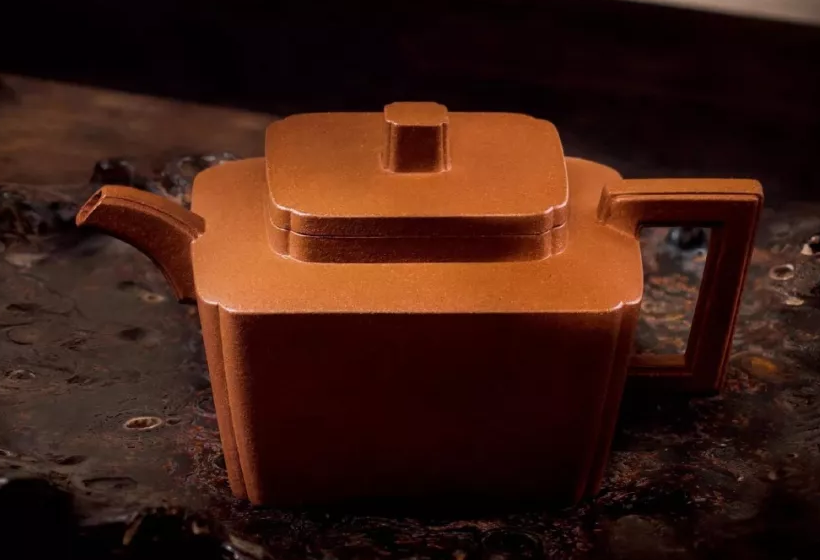
A square Yixing teapot can be surprisingly soft in outline. A shoulder swells, a corner eases into a curve, and a six-sided lid carries the eye down toward the foot. These are the details worth looking at before the auction price catches your attention.
In China, fangqi describes a family of angular forms, including four-sided, six-sided and other faceted designs. This selection brings together ten examples from Chinese auction literature, from Chen Mingyuan’s Chuanxiang form to Gu Jingzhou’s modern interpretations. It is a tour of square Yixing teapots and their design, rather than an all-time price ranking.
Reading the prices: these are historical published results in Chinese yuan (RMB/CNY), not current valuations. Maker and period attributions follow the cited auction literature, rather than an independent examination by Sandao. The Yulu result covers a complete five-piece set. Where a price could not be securely matched to the pictured object, it is not assigned.
Square Yixing teapots at auction: a quick reference
| Form / attribution | Sale cited | Published result, RMB |
|---|---|---|
| Chuanxiang / Chen Mingyuan | Poly Huayi, Shanghai, 2016 | 34,500,000 |
| Cang Liufang / Gu Jingzhou | Beijing Yirong, autumn 2013 | 17,825,000 |
| Yulu five-piece set / Gu Jingzhou | Jiangsu Hexin, spring 2018 | 17,250,000, reported set total |
| Imperial-poem square pot / Qianlong attribution | China Guardian, spring 2011 | 8,625,000 |
| Waisted square form / Chen Mingyuan attribution | Pictured lot not securely matched | Not assigned |
| Low monk-cap / Gu Jingzhou | Beijing Poly, spring 2012 | 7,820,000, reported |
| Hanping / Xu Longwen | Xiling Yinshe, autumn 2017 | 7,245,000, reported |
| Hexagonal Zhu Ni / Jiang Jinhou | Beijing Changfeng, spring 2011 | 6,670,000, contemporary report |
| Hanfang / Licheng attribution | Beijing Changfeng, 2011 | 5,957,000, reported |
| Four-footed dragon vessel / Chen Mingyuan attribution | Beijing Yirong, autumn 2013 | 5,750,000, reported |
A hammer price is the winning bid; a total including the buyer’s premium is a different figure. Do not assume two reports use the same basis. For example, a June 2018 report on the Yulu set gives RMB 15 million, while later auction summaries give RMB 17.25 million. The original settlement basis has not been independently confirmed here.
1. Chuanxiang: Chen Mingyuan’s compact square form
The opening photograph shows the Chuanxiang form: broad shoulders, a tapering body and a rectangular handle, with recessed corners carrying the design through the lid and foot. Its strength comes from proportion rather than added ornament.
Poly’s retrospective records Chuanxiang as lot 621 at Poly Huayi’s inaugural Shanghai auction in 2016, with a result of RMB 34.5 million. It also records the inscription ling wo xiong zhong shu chuan xiang, which can be rendered as “letting the books within me give forth fragrance.” Tea and literary life meet in a few words.
2. Cang Liufang: Gu Jingzhou’s six-sided geometry

Start at the knob and follow a corner downward. The lid, shoulder, body and foot repeat the six-sided structure, while the swelling sides prevent the pot from looking like a rigid box. The two profiles also show how a loop handle can sit comfortably alongside an angular body.
A review of Gu Jingzhou’s angular forms reports RMB 17.825 million at Beijing Yirong’s autumn 2013 sale. This is a result for a particular catalogued object, not a price attached to every pot called Cang Liufang. Shape names are shared across many makers and periods.
3. Yulu: one teapot, four cups and a shared design
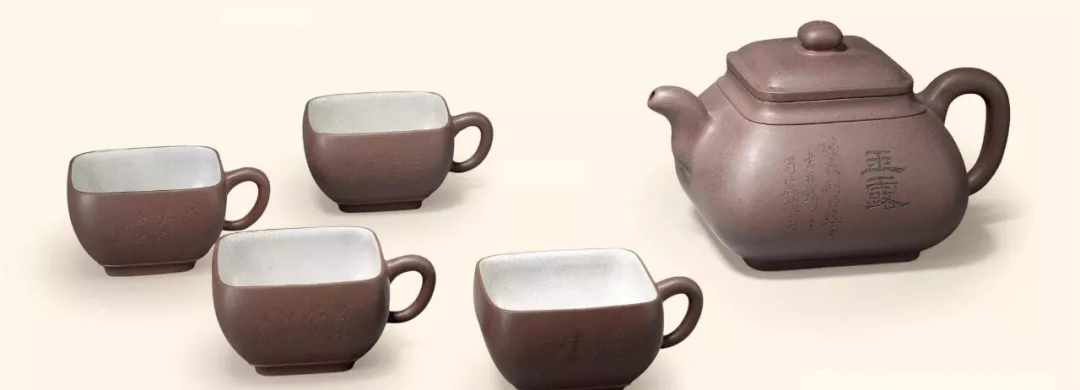
Yulu means “Jade Dew.” Here, the rounded-square outline appears in both the pot and the four cups. Look at the repeated corner treatment and the way the cup handles echo the teapot handle. The ensemble has a rhythm that a photograph of the pot alone would miss.
The source describes inspiration from the ancient Chinese gui, a food and ritual vessel. The engraved poetry evokes flowers, tea prepared outside a thatched hall and a solitary crane. A published auction summary lists the five-piece set at RMB 17.25 million at Jiangsu Hexin’s spring 2018 sale. That figure belongs to the entire set; it should not be compared as if it were the price of one teapot.
4. A Qianlong-attributed square pot with gold and silver decoration
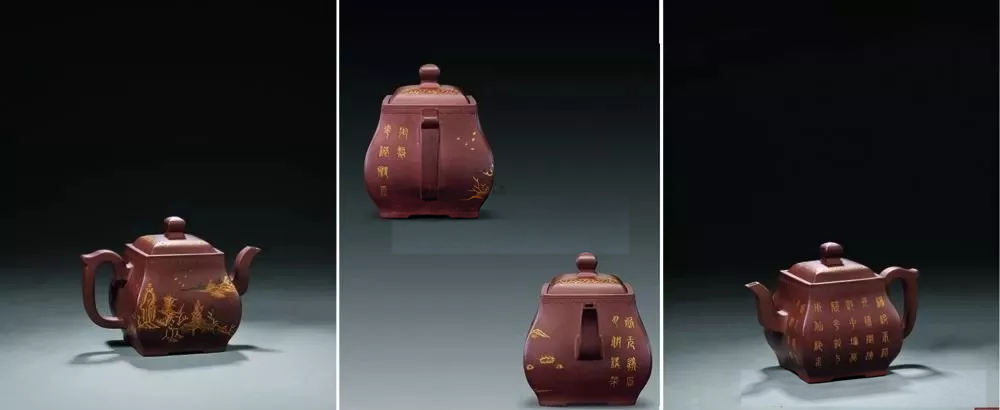
The square body gives the painter separate surfaces for a landscape and lines of poetry. Gold decoration picks out the scene and lettering against the reddish clay, while the curved spout and softened corners keep the form from appearing severe.
A contemporary market report records RMB 8.625 million for a Qianlong-attributed imperial-poem square pot at China Guardian’s 2011 spring sale. The imperial attribution is the auction description, not something established by gold decoration or a reign mark alone. For the different ways gold was applied to Chinese Yixing teapot surfaces, see our guide to miao jin and gilding.
5. The waisted square form: a pause before quoting a price
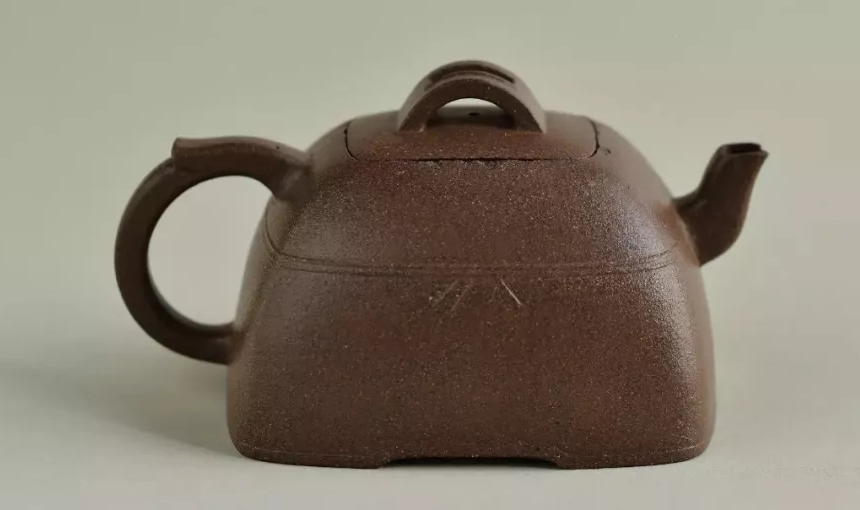
This low pot is a useful study in rounded corners. A narrow line around the body establishes the waist, while the arched knob and loop handle answer each other. The darker, granular surface leaves the silhouette easy to read.
The supplied compilation pairs this photograph with a 2012 result, but that pairing could not be securely checked. Poly’s own retrospective instead records a Chen Mingyuan waisted square pot inscribed by Cao Lianrang at its autumn 2013 sale, lot 6023, for RMB 9.89 million. Without a firm photographic match, that separate result is not assigned to the pot shown here.
6. Gu Jingzhou’s low monk-cap form
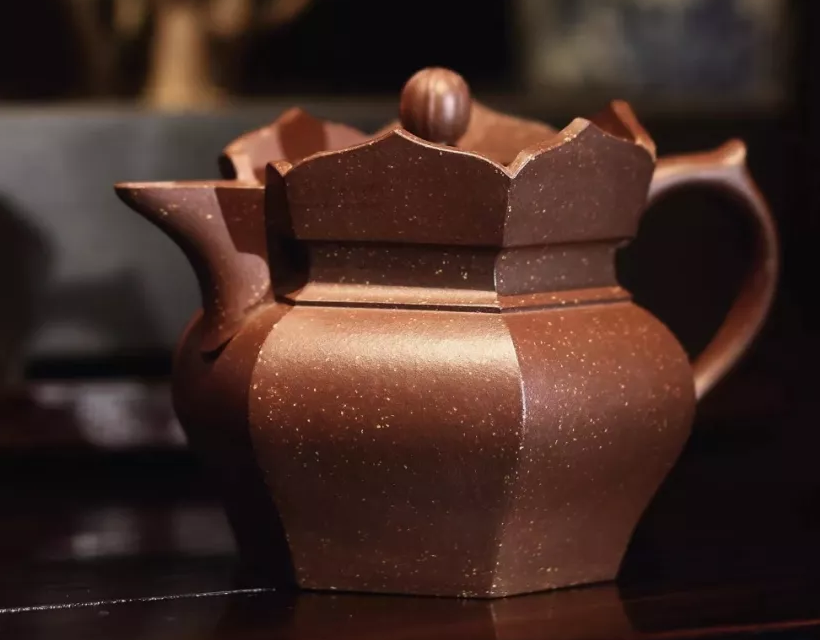
The raised, crown-like rim makes this one immediately recognizable. Its facets continue below the shoulder, but the body remains full and rounded. Move your eye from the high points of the rim to the shoulder: the changes in height give the pot much of its character.
A published review of Gu Jingzhou auction results lists a low monk-cap pot at RMB 7.82 million in Beijing Poly’s spring 2012 sale. The source compilation describes an archaistic work with a Dabin inscription and an internal Jingji mark. Such combinations need documentary context; a historic name on a pot does not, by itself, identify its maker.
7. Xu Longwen’s Hanping: a tall body with curved planes
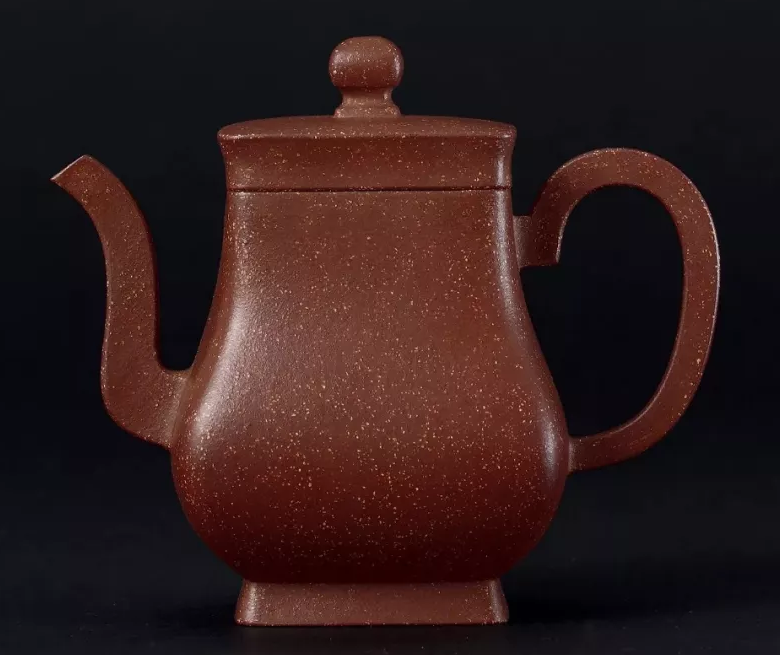
The Hanping form stretches the square body upward. Its sides curve into the lower body, the spout rises in a long sweep, and the handle leaves a generous open space behind the pot. From a distance it looks architectural; closer up, the granular clay softens that impression.
The auction account identifies it as a Xu Longwen pot bearing the Qingyuxuan mark, formerly in Gong Xinzhao’s collection, and reports RMB 7.245 million at Xiling Yinshe’s autumn 2017 sale. A contemporary sale preview also identifies that collection history. For a collector, the box, inscriptions and documentary trail deserve attention alongside the clay vessel.
8. Jiang Jinhou’s hexagonal Zhu Ni pot
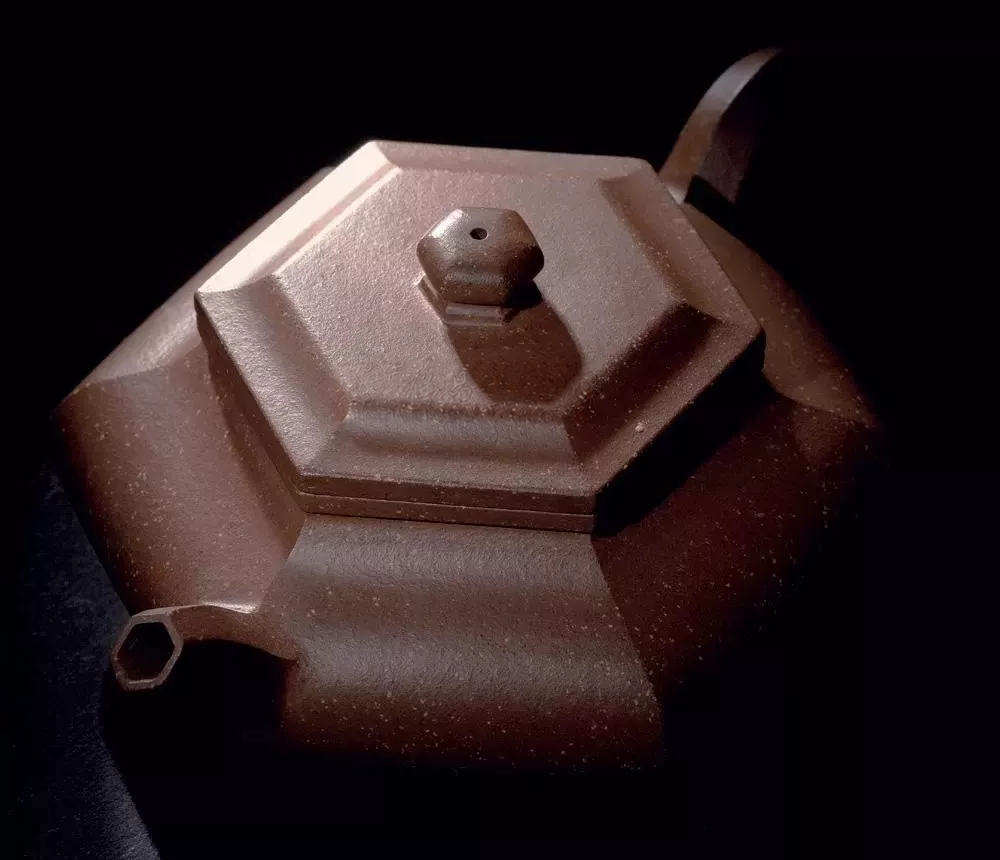
This close view makes the construction easy to follow. A six-sided knob sits above a stepped hexagonal lid, and the spout opening repeats the angular vocabulary. The pale specks are visible inclusions in the photographed clay; a photograph does not establish that they contain gold.
The pot appeared in the 2011 Changfeng preview as lot 115, catalogued under Jiang Jinhou and the Wanli period. A contemporary post-sale report gives RMB 6.67 million. That differs from the RMB 6.472 million in the supplied compilation; the contemporary reported figure is used here.
9. Licheng’s Hanfang: a quieter, upright square form
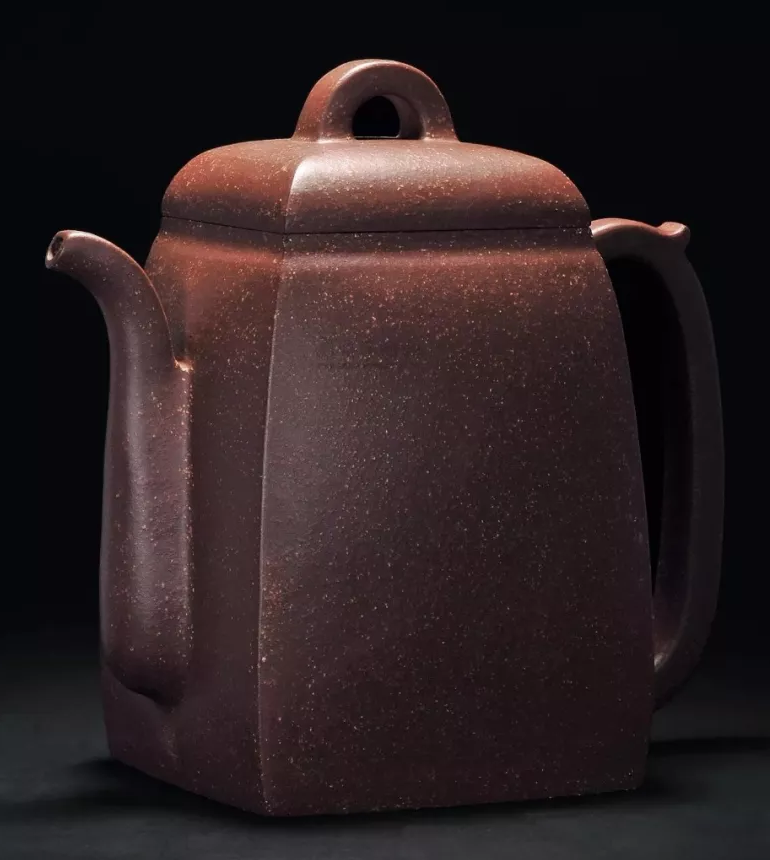
The tall body has broad faces, rounded shoulders and a domed lid with an arched knob. Its long spout and rear handle sit close to the body, giving it a more contained outline than the Hanping example above. The difference is worth seeing side by side: “square” covers a wide range of proportions.
A published survey of angular auction pieces attributes this Hanfang to Licheng and reports RMB 5.957 million at Beijing Changfeng in 2011. The available reference does not establish a full sale date or lot number, so the figure is retained as a reported historical result. It is not a current appraisal or proof of the maker’s identity.
10. A four-footed dragon vessel attributed to Chen Mingyuan
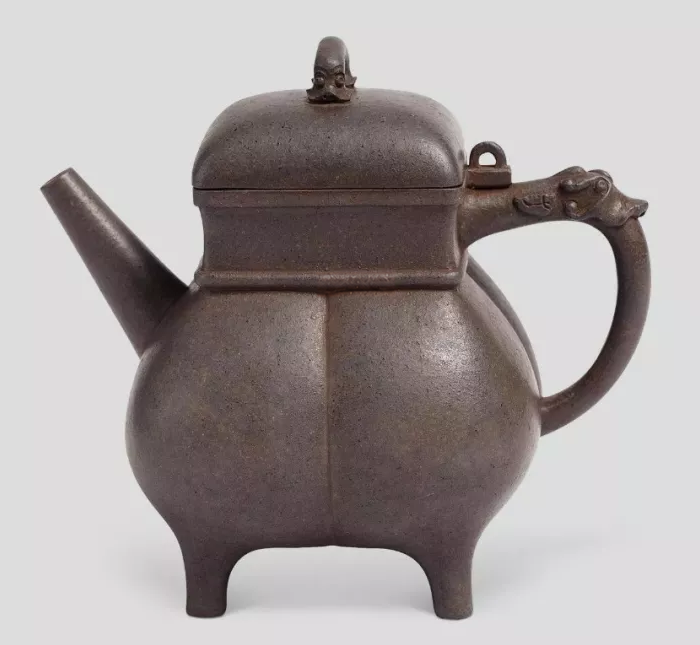
This final pot brings sculptural detail into a geometric design. The four feet lift the body off the surface, while the square upper section, rounded lower body and animal-head ornament make it quite different from a plain square tea pot. Its archaistic character recalls Chinese bronze vessels.
A 2014 account of the sale reports RMB 5.75 million at an autumn 2013 auction; the source compilation identifies the house as Beijing Yirong. The carved lid and handle details reward a close look, but the attribution still belongs to the auction literature rather than to what a photograph can prove.
What these ten pots teach you to look for
Forget the prices for a moment and compare three things: how the lid meets the body, how a corner travels through the form, and how the spout and handle balance each other. A plain surface can reveal those relationships just as clearly as a decorated one. Our illustrated Yixing shape guide gives you more forms to compare.
When assessing an antique Chinese Yixing teapot, put the catalogue, provenance, condition report and any restoration history beside the photographs. A familiar seal or an expensive result cannot do that work for you. Our ヴィンテージ 宜興 茶壺 ガイド explains how to approach age and documentation.
If you are choosing a Chinese tea pot for everyday brewing, these museum-level and auction examples offer design lessons without setting your budget. Start with a comfortable size, a reliable pour and a seller who can support their claims. The 宜興 茶壺 価格ガイド covers that practical side.
Image note: supplied photographs follow the original ten-entry sequence. Publisher overlays and detached inset strips have been removed or cropped; the original vessel shapes, visible artistic inscriptions and clay details have been retained. Photographs illustrate the cited forms and do not constitute independent authentication. Some linked historical references are in Chinese.