Guías de té y utensilios
White Tea Pile-Up Processing: Why Timing Changes Flavor

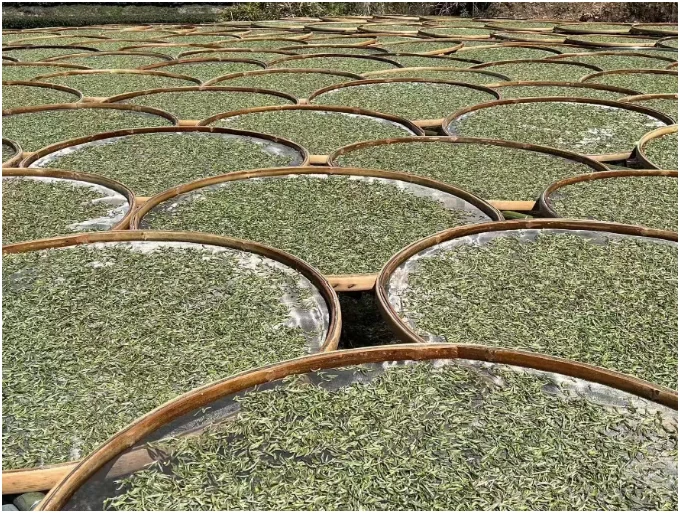
Pile-up processing brings partly processed leaves together more thickly than ordinary spreading. In some white tea production systems, it is used to change moisture distribution, leaf temperature and flavor development. It is a controlled manufacturing choice, rather than a necessary step in every traditional white tea.
Sweetness can improve while freshness declines
Experiments have compared different treatment durations. In general, reducing a raw grassy note can bring sweet and floral impressions forward, but longer treatment is not always better. Leaf moisture, depth of material, ventilation and temperature influence the result alongside the clock.

Read the study within its own conditions
A 2023 Journal of Tea Science study found the best flavor at 12 days within its tested protocol. Bitterness and astringency first declined and then increased, while sweetness rose and then fell. That is evidence of a turning point in those samples, not a universal instruction to pile every tea for 12 days. A different experiment measured in hours is not directly interchangeable with it.
What a buyer should ask
Ask whether the tea uses a conventional or modified process, what flavor the producer intended and whether the product description is accurate. A mellow or dark-looking tea is not proof of a long storage history. Do not add water or keep finished tea warm to imitate factory pile-up processing: you cannot reproduce the monitored conditions, and damp storage can spoil tea.
