Sandao · Chinois ustensiles pour le thé & culture
Lu Zhenghao Tea: Company, Craft & Longjing Collections
Chinese Tea Brands & Companies
Lu Zhenghao (卢正浩) is a Hangzhou tea brand with roots in Meijiawu and a particular emphasis on Longjing green tea. The company named on its official website is Hangzhou Zhenghao Tea Co., Ltd. (杭州正浩茶叶有限公司). Its story connects a family’s tea-making experience with gardens, processing facilities and a range of traditional and contemporary tea presentations.
For someone choosing Chinese tea overseas, the useful starting point is the relationship between brand, place and product. Lu Zhenghao is the brand; West Lake Longjing and Qiantang Longjing identify different production areas. Both appear in the official collection, so the name on the front of a box is only the beginning.
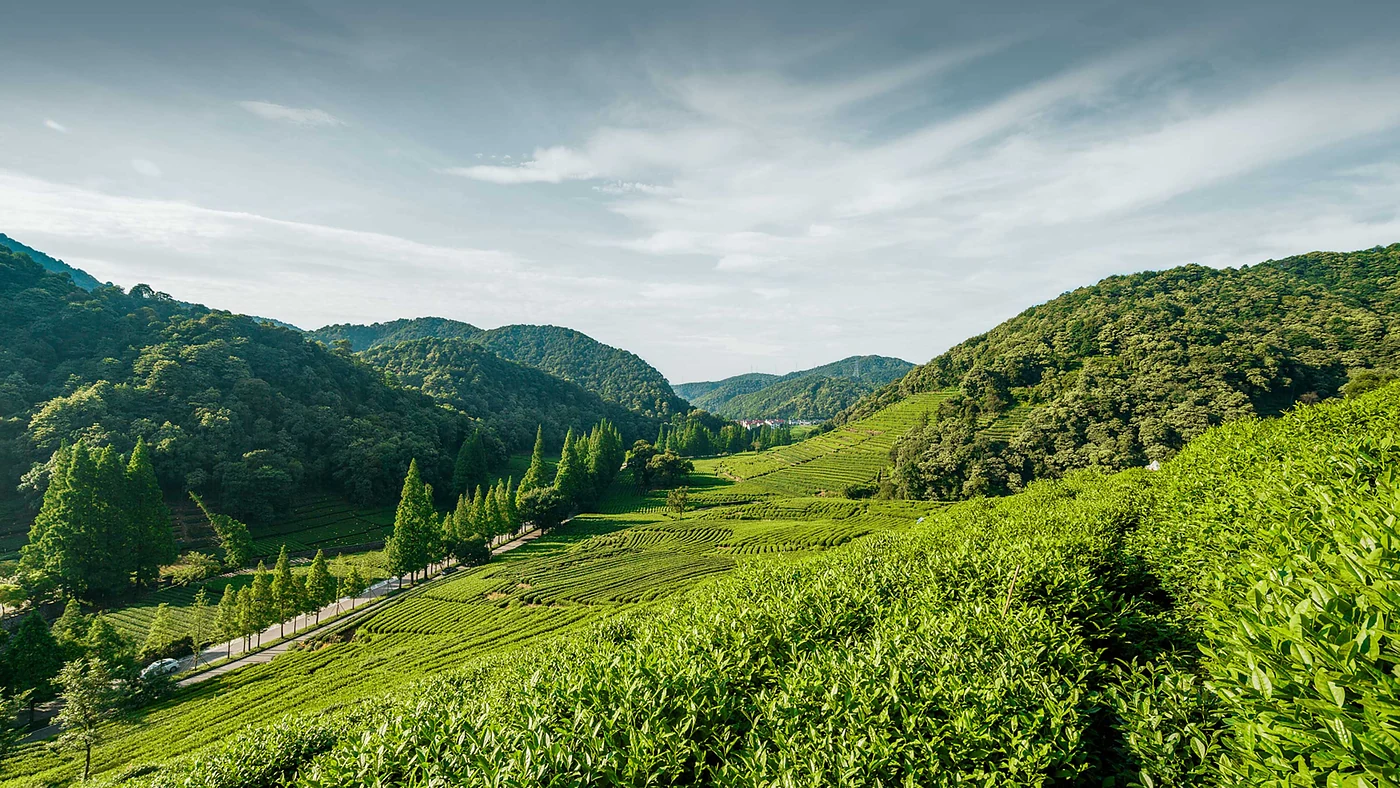
The company behind the Lu Zhenghao brand
The official company introduction names Hangzhou Zhenghao Tea Co., Ltd. and places its establishment in the 1990s. The footer gives the brand’s tea-estate address as No. 10 Meijiawu, Meiling South Road, Xihu District, Hangzhou. This profile follows the name used by that source, rather than adding “Lu” to the company’s Chinese legal-style name.
The business describes a chain that connects tea sourcing, preliminary processing, refining, research, storage and sales. It combines the identity of a traditional tea house with a more structured production and distribution operation. That makes it useful to consider the company’s organization separately from the craftsmanship of an individual tea.
Meijiawu roots: a person, a family and a brand
The brand-history page introduces Lu Zhenghao (1933–1991) through his work with Meijiawu village and its tea industry. Its account associates him with the development of Meijiawu Longjing and the Lu-style approach to tea making. The site also presents historical photographs and accounts of visits to the village.
The successor page identifies his daughter, Lu Jiangmei, as the founder of the modern brand, established in her father’s name in 1991. This is an important distinction: the person’s earlier village work, the brand’s founding and the company’s establishment are different milestones.

| Period | What the official account describes |
|---|---|
| 1952 | An early milestone in Lu Zhenghao’s work with Meijiawu village, later referenced by the Heritage 1952 collection. |
| 1991 | Lu Jiangmei establishes the Lu Zhenghao brand in her father’s name. |
| 1990s | The period given for the establishment of Hangzhou Zhenghao Tea Co., Ltd. |
| 2019 | The company introduction records the establishment of Hangzhou Zhenghao Fumei Tea Co., Ltd. in Changkou, Fuyang. |
The website presents Lu Jiangmei as a tea-making master and an inheritor associated with West Lake Longjing green-tea making. Its family narrative also speaks of three generations of tea people. For a closer look at the personal story, read our separate Lu Jiangmei and Meijiawu family-history article.
Tea sources and the importance of origin
The tea-source section describes contracted management of selected plots, working with local growers, recording the location and conditions of tea fields, and checking incoming leaves. It reports a 1,030-mu tea-garden base in the core area. This is a figure published by the company, not a new measurement made for this profile.
The site’s origin introduction discusses Shifeng, Longjing and Meijiawu, among other West Lake tea-growing places. These names help explain different products within the brand. They should still be read alongside the origin stated for the exact item: a company’s association with Meijiawu does not make every product a Meijiawu tea.
The garden pages also display certification material. Such documents have their own scope and dates; a historical image is not enough to describe every current product as organic or currently certified. For the basic geographical distinction, see West Lake Longjing versus other Longjing teas.
From a tea house to production and distribution
The company page describes preliminary-processing factories in its sourcing areas and a larger production operation in Changkou, Fuyang. It gives 2019 as the establishment year of Hangzhou Zhenghao Fumei Tea Co., Ltd., and describes a facility of about 18,000 square meters bringing research, production, warehousing and logistics together.
The practical thread is coordination: managing fresh leaves, keeping processing consistent and moving finished tea into suitable storage and distribution. The website also presents capacity, sales and certification claims. Those are company statements with a specific business context; they are not used here as an independent ranking of tea producers or as a promise about the contents of a particular packet.
What does “Lu-style craft” mean?
The Lu-style craft page organizes its method into ten process stages and ten hand movements. It places sourcing and finished-tea assessment in the same sequence as pan work, rather than treating the visible hand-firing stage as the whole production process.

| Stages in the official sequence | What they cover |
|---|---|
| Source selection and plot management | Choosing tea sources and recording responsibility for tea plots. |
| Receiving and spreading fresh leaves | Checking harvested material and laying it out before processing. |
| Initial pan-firing (qingguo) | Heating, reducing moisture and beginning the leaf’s characteristic shape. |
| Moisture equalization (huichao) | Resting and sorting the partially processed leaves before the next pan stage. |
| Finishing pan-firing (huiguo) | Further shaping and drying. |
| Refining and assessment | Sorting finished tea and evaluating batches. |
| Traditional dry storage | The final storage stage described in the company’s craft account. |

The hand-movement section illustrates shaking, pushing, pressing and smoothing actions. Tea makers adjust these movements to the leaves and the stage of processing. The illustrations below introduce the method; they are not photographs documenting the making of a retail batch.
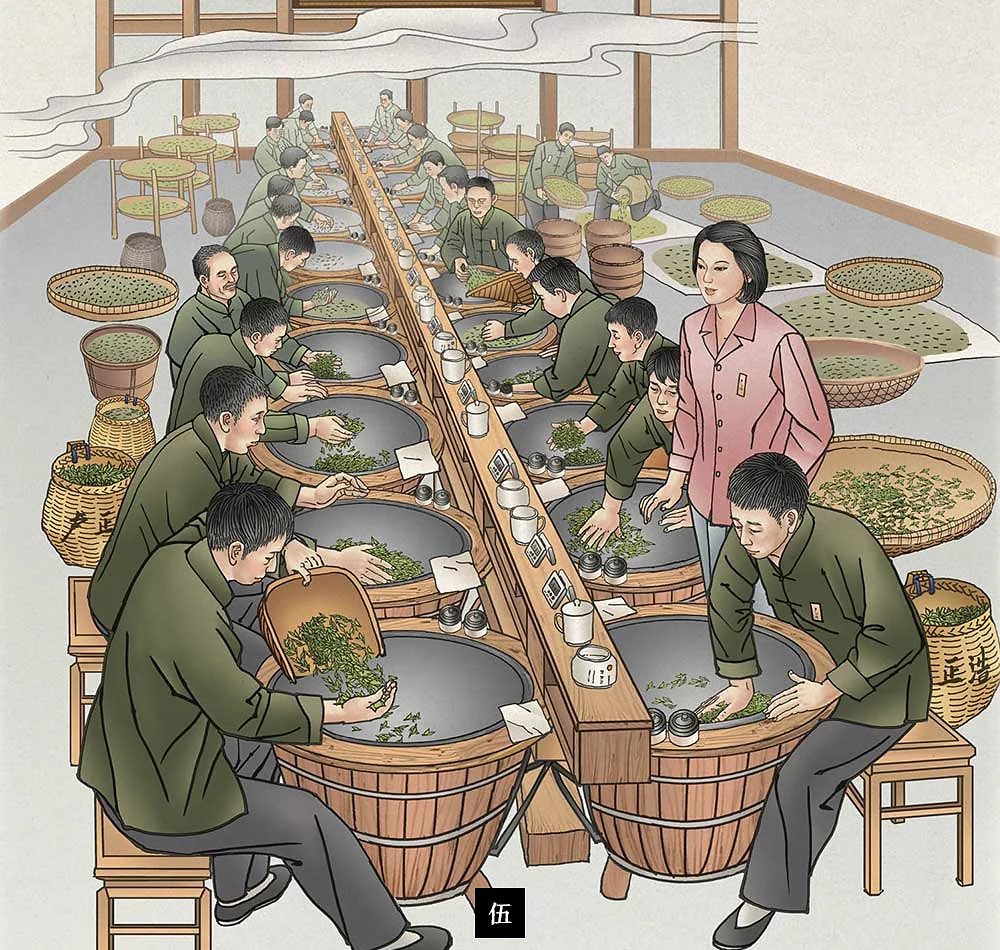
The product pages describe different combinations of hand work and modern processing. A brand’s emphasis on traditional craft should therefore lead you to read the method given for your chosen product, rather than assume the entire catalog has one identical production method.
The Longjing collections: read the origin column first
The official product-family page lists nine collections. Some are West Lake Longjing, while others are explicitly described as Qiantang Longjing. The table summarizes those published descriptions, not current stock or a tasting comparison.
| Collection | Chinese name | Origin in the official description |
|---|---|---|
| Shijia / Family Heritage | 世家系列 | West Lake Longjing; the listed example specifies Shizifeng. |
| Gold Award | 金奖系列 | West Lake Longjing core production area. |
| Heritage 1952 | 传承1952 | Qiantang Longjing. |
| Xizi Legends | 西子传奇 | Qiantang Longjing. |
| Shi · Lianxin | 狮·莲心 | West Lake Longjing; Shizifeng. |
| Lu — Shi designation | 卢(狮字号) | West Lake Longjing; the Shifeng mountain area. |
| Zheng — Long designation | 正(龙字号) | West Lake Longjing; Wengjiashan, Yangmeiling and Manjuelong. |
| Hao — Mei designation | 浩(梅字号) | West Lake Longjing; Meijiawu. |
| Paper-Pack Collection | 纸包系列 | The listed example identifies the Qiantang production area. |

The names bring together family heritage, local geography and presentation style. “1952,” for example, refers to a point in the family narrative; it is not the harvest year of tea sold today. Mingqian describes picking before Qingming, while a grade and a specific growing area are separate pieces of product information.
How the brand describes flavor and appearance
The quality section uses five themes: color, aroma, taste, leaf shape and sinking behavior. It highlights fresh green tones, fragrant aromas, sweetness and a neat, flattened leaf. These are useful descriptions of the character the brand aims for.
Use them as a vocabulary for tasting, not a one-step authenticity test. How quickly a leaf sinks also depends on the leaf’s condition and the brewing setup; sinking speed alone cannot prove origin or establish a universal quality ranking. Likewise, photographs of bright green tea do not determine how every batch should look in your cup.
Tea presentation, stores and service
Alongside tea making, the official site shows a contemporary retail identity: green signage, wooden counters and a setting intended for looking at and discussing tea. The company page labels its store images as design renderings, so they are presented here with that same distinction.


The homepage links to the brand’s WeChat/Youzan shop, Tmall flagship and JD flagship, and displays a consumer-service number of 400 926 1818. For current products, opening arrangements or a visit to Meijiawu, use the contact details on the official website to confirm the latest information.
Choosing a Lu Zhenghao tea
First decide whether you want West Lake Longjing or a Qiantang Longjing from the same brand. Then compare the exact harvest information, declared grade, net tea weight and packaging. A large presentation box does not necessarily contain more tea, and a collection name does not replace the product’s origin statement.
Check the production date and storage instructions on the package. The official catalog gives different shelf-life descriptions for different products, so one duration should not be applied to the entire brand. For overseas buying, also consider how quickly you will finish an opened pack and how it will be transported and stored.
Our West Lake Longjing buying checks and storage guide cover those questions in more detail. For brewing, a heat-safe glass or glazed porcelain vessel is a straightforward starting point; follow our Longjing brewing guide and adjust the result to the tea in hand.
Frequently asked questions
What company name does the official website use?
Hangzhou Zhenghao Tea Co., Ltd. (杭州正浩茶叶有限公司). Lu Zhenghao (卢正浩) is the brand name. This is the identity presented by the website, rather than a new corporate-registry verification.
Who founded the modern Lu Zhenghao brand?
The successor page says Lu Jiangmei established it in 1991 in her father’s name. The earlier work of Lu Zhenghao in Meijiawu is part of its heritage.
Is every Lu Zhenghao product West Lake Longjing?
No. The official product page identifies Qiantang origin for collections including Heritage 1952, Xizi Legends and the listed paper-pack example.
How is this profile different from Sandao’s family-story article?
This page maps the company, craft, sourcing and product collections. The family-story article gives more space to the father-and-daughter narrative. Both belong in the Longjing tea topic hub.
Sources and image credits
Prepared from the Lu Zhenghao official website, particularly its company, master, successor, source, craft, quality and product-family pages linked above. Reviewed October 24, 2026. Undated scale and capacity figures are attributed company descriptions, not current audited figures. Images: Lu Zhenghao official website. Store renderings and process illustrations are identified in their captions; physical Chinese signage is retained with English captions explaining the context.