चाय और चाय के बर्तनों के मार्गदर्शक
West Lake Longjing Tea Price: What Are You Paying For?
There is no single price that proves a tea is genuine West Lake Longjing. A useful comparison starts with the same origin claim, harvest year, net weight and type of packaging. A bargain is only a bargain if the tea is accurately described and enjoyable to drink.

What should a Longjing tea price comparison include?
Compare the same kind of offer before deciding that one tea is expensive. A price for 50 g of dry tea, a quote per jin and a gift set with cups are three different things. The following checklist helps separate the tea from the presentation and delivery costs.
| Compare | What to record |
|---|---|
| Origin | The stated production area and supporting information. |
| Harvest | The year and picking period of the batch being shipped. |
| Net weight | The weight of tea, excluding the box and accessories. |
| Processing | Which stages were done by hand or machine. |
| Presentation | Plain packaging, sealed portions, gift box or included teaware. |
| Delivered cost | Currency, delivery charges and applicable taxes. |
A dated quotation can illustrate one seller’s offer. It should not become a permanent price range for an entire growing area. Use the net-weight calculation below to compare quotations on the same basis.
Why can one bag cost much more?
Specific origin: a documented West Lake batch is a different proposition from Longjing described only as Zhejiang green tea. A more specific village or hillside claim needs supporting information; the name on the box is not enough.
Picking and production: careful picking, sorting, yield and skilled firing affect cost. ‘Hand pan-fired’ should be explained in terms of which production stages involved handwork. It does not prove where the leaves grew.
Retail costs: sealed small packs, gift boxes, overseas storage and distribution can all affect the final price. None automatically improves the flavor.

Why do prices differ between Longjing regions?
Part of the difference is what is being claimed: a documented West Lake origin is more specific than a general Longjing description. Harvest timing, the available batch, picking and processing work, storage, branding and retail presentation add further variables. The importance of each factor depends on the particular product; there is no fixed percentage split that applies to every packet.
Does a low Mingqian price prove the tea is fake?
No single retail cutoff can establish authenticity. A low quotation is a reason to check the producer, origin, harvest, grade and net weight more closely. A high price cannot establish those details either. Compare the actual labels and records, rather than using a universal “below this price means fake” rule.
How much does hand-processing explain?
The National Tea Quality Inspection and Testing Center describes all-hand, mechanical and combined processing methods. Ask which method applies to the batch, and which stages a seller means by “handmade.” A craft designation alone does not tell you the leaf origin or guarantee that you will prefer the flavor.
A March 18, 2026 field report from Wengjiashan recorded a grower’s different quotations for hand-processed and machine-processed tea. That is a dated local example, not a minimum or maximum for all genuine West Lake Longjing.
Does a more expensive region always taste better?
Compare individual batches rather than assigning one permanent flavor score to each region. Cultivar, weather, picking, firing, storage and brewing can change the result. A regional reputation or an unsupported claim about chemical composition is not a substitute for knowing the tea you are buying.
For a fuller comparison, read West Lake, Qiantang and Yuezhou origin differences. For a purchase, use our Longjing tea buying checklist. References reviewed October 24, 2026.
Does Mingqian always justify a premium?
Mingqian means picked before Qingming in the stated year. Early spring supply can be limited, and a carefully made batch may command more. But harvest timing is one variable, not a guarantee of better taste.
Yuqian commonly refers to the period after Qingming and before Guyu. A later spring batch can be a rewarding everyday tea. Cultivar and weather matter too: comparing two different picking dates without knowing the plants and conditions can be misleading.
Read our Mingqian versus Yuqian comparison before treating a calendar term as a quality grade.
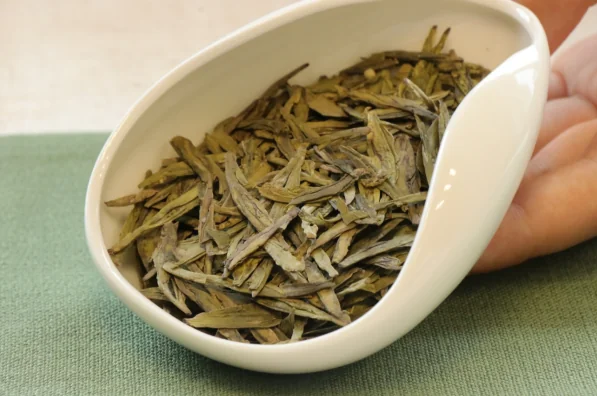
Compare the price of tea, not the size of the box
Use this simple calculation: tea price ÷ net grams = price per gram. Then add the delivery costs that apply to your destination. Keep currencies separate unless you use an exchange rate dated to the comparison.
In Chinese listings, one jin is 500 g. It is not a US pound, which is about 454 g. A price quoted ‘per jin’ cannot be compared directly with a price per pound or per 100 g.
For a purely illustrative example, a $50 bag containing 50 g costs $1 per gram. At 3 g per brewing session, the dry leaf cost is $3 per session, before delivery. Reusing those leaves for several infusions adds cups, but does not turn each infusion into a fresh 3 g serving.
When is the more expensive tea worth it?
- For daily drinking: choose a clean, well-stored batch you actually enjoy and can afford to brew regularly.
- For exploring origin: buy small, traceable samples before committing to a large quantity.
- For a gift: consider presentation and reliable delivery, while checking that the tea details are as clear as the packaging.
Ask for the producer, harvest year, picking period, pack weight and traceability information. A high price cannot replace those answers. If two samples cost very different amounts, brew them under the same conditions and decide whether the difference matters to you.
Before ordering, use the West Lake Longjing authenticity checklist. Find the rest of the series in our Longjing tea guide.