Sandao · Китайский язык чайная посуда и культура
Xiaguan Tuocha: Yunnan Pu-erh Tea, Company & Products
← Chinese Tea Brands & Companies
Xiaguan Tuocha is a Chinese tea brand closely associated with Dali, Yunnan, and the distinctive bowl-shaped compressed tea called tuocha. Yunnan Xiaguan Tuocha (Group) Co., Ltd. develops, produces and sells tea, with a catalog spanning tuocha, cakes, bricks and other compressed formats.

Company at a glance
| Chinese company name | 云南下关沱茶(集团)股份有限公司 |
|---|---|
| English name used here | Yunnan Xiaguan Tuocha (Group) Co., Ltd. |
| Company location | Dali, Yunnan, China; Xiaguan and Yinqiao sites |
| Brand history | Tuocha creation traced to 1902; factory predecessor established in 1941 |
| Main business | Tea research, production, sales, distribution and tea-culture communication |
| Product focus | Compressed teas, including raw and ripe pu-erh products |
| Official website | xgtea.com |
A brand history and a factory history
The Ministry of Commerce’s time-honored-brand museum dates the brand to 1902 and identifies the Kangzang Tea Factory, established in 1941, as the company’s predecessor. It records restructuring in 1994 and 2004, and China Time-honored Brand recognition in 2011. These dates describe different stages; 1902 should not be presented as the registration date of today’s company.
Dali’s role in tea trade and processing helps explain the brand’s identity. It is also important to separate a factory address from a tea’s raw-material origin. A product made in Dali does not, by that fact alone, contain leaves grown only in Dali.
Main business: research, making tea and reaching customers
Xiaguan’s business brings together tea development, processing, sales and brand communication. The official site presents a product center, sales network, franchise information and tea-learning sections. It lists separate contacts for sales and marketing, alongside the administrative office.
For consumers, that means checking an identifiable product and batch rather than relying on a brand name alone. For a trade buyer, product type, sample, quantity, packaging and delivery requirements are the starting points for an enquiry. A company profile is an introduction, rather than an offer of stock or a statement that Sandao represents the manufacturer.
Main products and their characteristics
| Product family | What makes it distinct | What to check |
|---|---|---|
| Tuocha | A rounded compressed form with a hollow underside; the catalog includes both raw and ripe pu-erh. | Raw or ripe designation, weight, year and batch. |
| Tea cakes | A flatter, usually round compressed format, listed separately from tuocha. | The tea inside the cake, rather than shape alone. |
| Tea bricks | A block-shaped format that makes a compact unit for handling and storage. | Ingredients, processing category and production information. |
| Jincha and other compressed teas | The official catalog keeps a dedicated jincha section and an additional “other” category. | Each item’s specification and intended preparation. |
Tuocha is a shape, not another word for ripe tea. A nest-shaped product can be raw or ripe pu-erh. Those processing descriptions matter more to a first purchase than the silhouette of the package.
Current catalog examples: Canger, Jinsi and miniature tuocha
The official product page identifies the 2026 Canger Tuocha as raw pu-erh, presented in a 250 gram single box under the Song He Yan Nian mark. The homepage also displays a 100 gram round-box Jinsi ripe pu-erh tuocha, Fuchunhe Bingdao ripe tuocha, and miniature tuocha packs in raw and ripe versions.
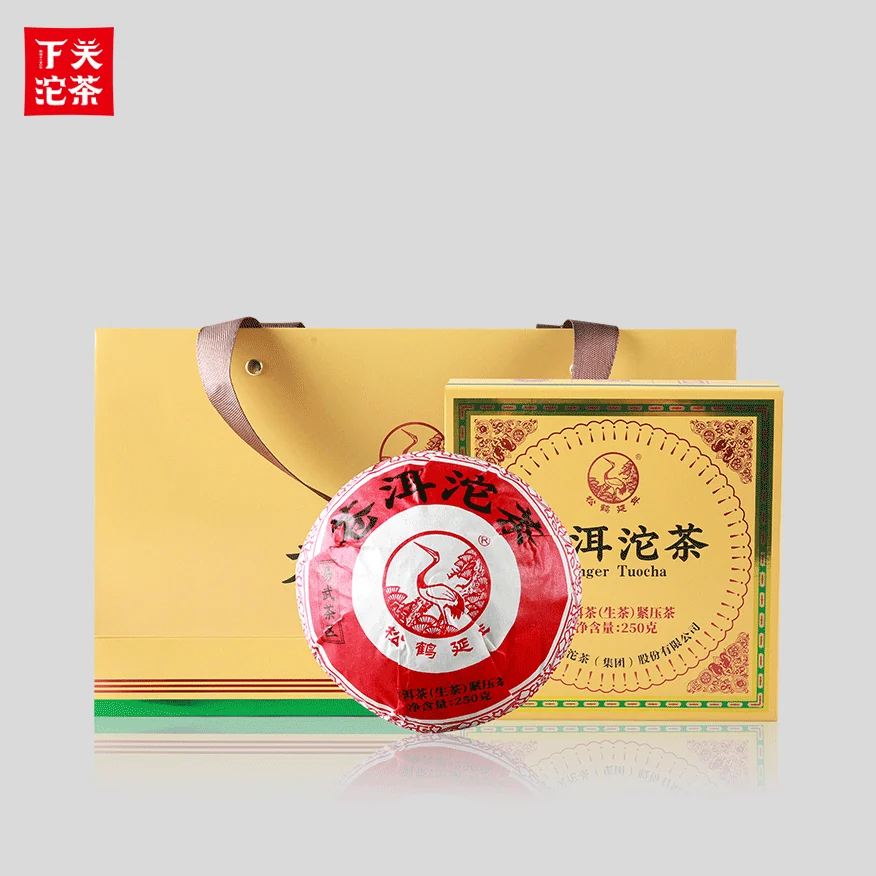
These are examples of how the company organizes products, not a promise that every pack is currently available. With similarly named products, compare the year, processing type and exact package. A place name printed in a product title should not be expanded into a more detailed sourcing claim without that batch’s supporting information.
Choosing between raw and ripe pu-erh
Raw pu-erh can offer a lively aromatic profile and noticeable astringency, particularly when young. Ripe pu-erh is generally chosen for a rounder, deeper drinking style. Individual batches, storage and brewing can change those impressions considerably. Neither category automatically guarantees a particular aroma or superior quality.
Start with a small quantity and the product’s brewing instructions. Break a compressed tea carefully into a manageable portion, then adjust leaf amount and infusion time to taste. A tightly pressed shape is not a quality score, and an older date does not by itself establish sound storage.

Craft, storage and tea culture
The Ministry of Commerce profile also records national intangible-cultural-heritage recognition for Xiaguan tuocha-making in 2011. Its significance lies in the making tradition, not in a claim that every product is made entirely by hand. Modern production and inherited skills can sit within the same business.
For the buyer, clear origin and batch information, suitable storage and a flavor you enjoy remain practical priorities. No health-treatment or guaranteed-investment claim is needed to appreciate a compressed tea.
Official contacts
| Xiaguan site | 13 Jianshe West Road, Xiaguan, Dali, Yunnan, China |
|---|---|
| Yinqiao site | Lingquan Avenue, Yinqiao Town, Dali, Yunnan, China |
| Sales and franchise enquiries | +86 872 2125090 |
| Marketing and publicity | +86 872 2151902 |
| Marketing email | xgtc1902@163.com |
| Administrative email | xgtea@xgtea.com |
Contacts are reproduced from the official website. Confirm current arrangements directly before placing an order or planning a visit.
Sources and editorial notes
Prepared on 28 October 2026 from the official website’s company page, product navigation, Canger product page and published contact details, with the Ministry of Commerce museum used to cross-check the historical timeline. Photographs are from the company website; original product marks and packaging are retained. Certification descriptions are not generalized to every tea or export market.