お茶と茶器のガイド
Authentic West Lake Longjing Tea: 3 Checks Before You Buy
To buy authentic West Lake Longjing tea, start with a traceable origin, then check the seller’s information against the official label on the package. Flat leaves and a pleasant roasted aroma are useful clues to quality. They cannot, on their own, tell you where a tea was grown.
Longjing, often called Dragonwell tea in English, is a Chinese green tea. West Lake Longjing is the more specific name: it refers to tea from the designated Xihu, or West Lake, production area in Hangzhou, Zhejiang, China. Longjing from the Qiantang and Yuezhou areas can be legitimate Longjing too; it should not be sold as West Lake Longjing. Hangzhou’s consumer education guidance explains this distinction.
This three-part checklist combines a look at the tea itself with label verification and questions for the seller. It also explains the 2026 label examples shown in the original spring-harvest report.
1. Inspect the leaves and taste the tea
Look for the familiar flat, smooth leaf shape, a reasonably even appearance and a clean smell. The picking standard varies with grade and harvest; “one bud and one leaf” is not a universal requirement for every genuine batch.
The dry leaves may be tender green, yellow-green or a warmer green with a yellow cast. Cultivar, picking time, firing, storage and photography all affect what you see. Neither a very bright green color nor a yellowish tone proves authenticity.
When brewed, Longjing may suggest fresh beans, chestnut, other gentle toasted notes or a light floral character. Those descriptions are reference points, not a checklist every cup must satisfy. Try a sample if possible. A clean, balanced cup is more informative than an elaborate flavor description on a sales page.
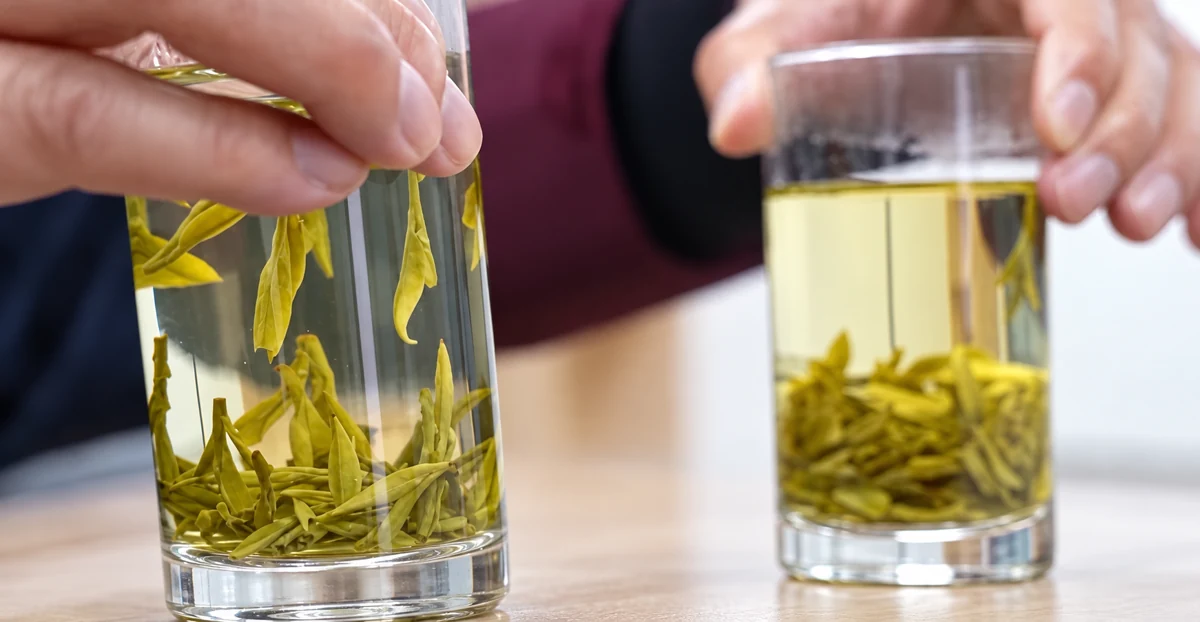
In the original report, an interviewee compared a newly harvested Shifeng tea with tea from the previous year. That was a comparison of particular samples. It does not establish that all older tea is poor, or that a paler, brighter infusion is automatically genuine. Leaf quantity, water and steeping time also change the result.
For a fair comparison, use the same cups, water, leaf weight and steeping time. Keep notes on aroma, balance and aftertaste. A sample can help you decide whether you enjoy the tea; origin still needs documentation.
2. Verify the West Lake Longjing traceability label
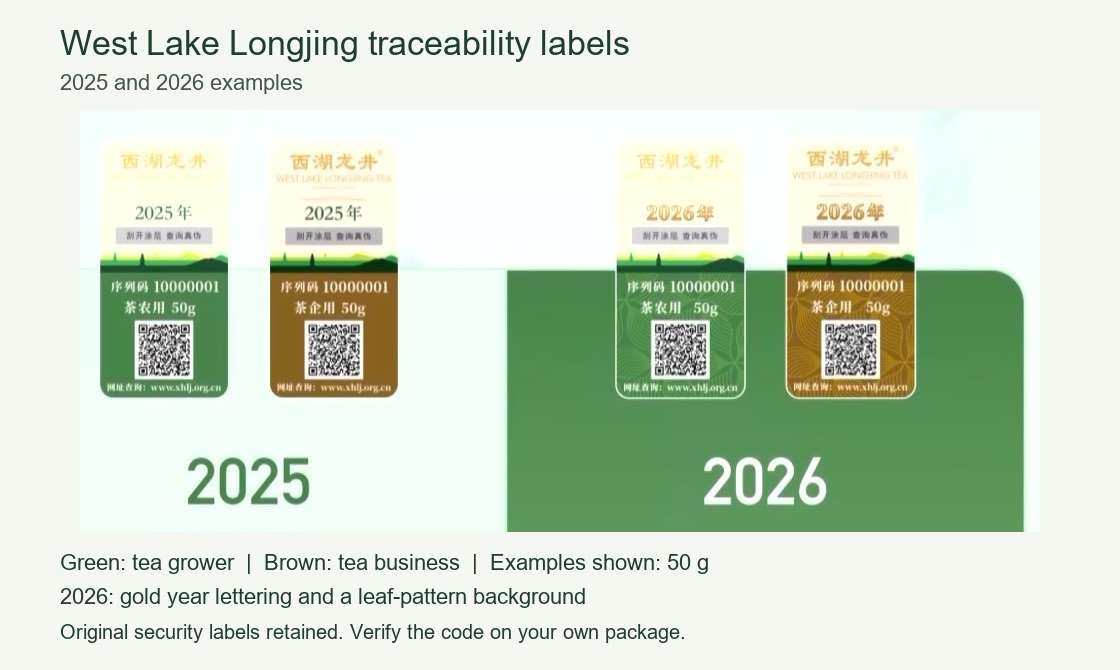
Look for the dedicated West Lake Longjing traceability label, rather than just a decorative seal or a printed claim of “authentic.” Hangzhou’s protection regulation requires the dedicated label to be displayed prominently on packaged West Lake Longjing; online product descriptions should also show it prominently.
The system connects labels with production and traceability records. China’s Ministry of Agriculture and Rural Affairs describes its use of numbered labels and quantities corresponding to the packaged tea. Check the relevant information together:
- Producer or business: does the record match the tea and seller’s explanation?
- Year and specification: do they agree with the package, stated harvest and net weight? Ask about any mismatch.
- Verification result: use the official service and follow the instructions on your own label. A QR code that opens a page is only the beginning of the check.
The examples above compare green grower labels and brown business labels. The supplied 2026 report describes gold year lettering and an added leaf-pattern background. These are year-specific visual references, not a permanent test for every harvest. Label designs can change, and a convincing-looking label still needs verification.
Start from the Hangzhou West Lake Longjing Tea Management Association website and its verification service. Its current website provides a scratch-code lookup. Use the code on the tea you receive, not the sample code in a photograph. If you are buying overseas, ask the seller how the retail pack relates to the original labelled batch, especially if it has been repacked.
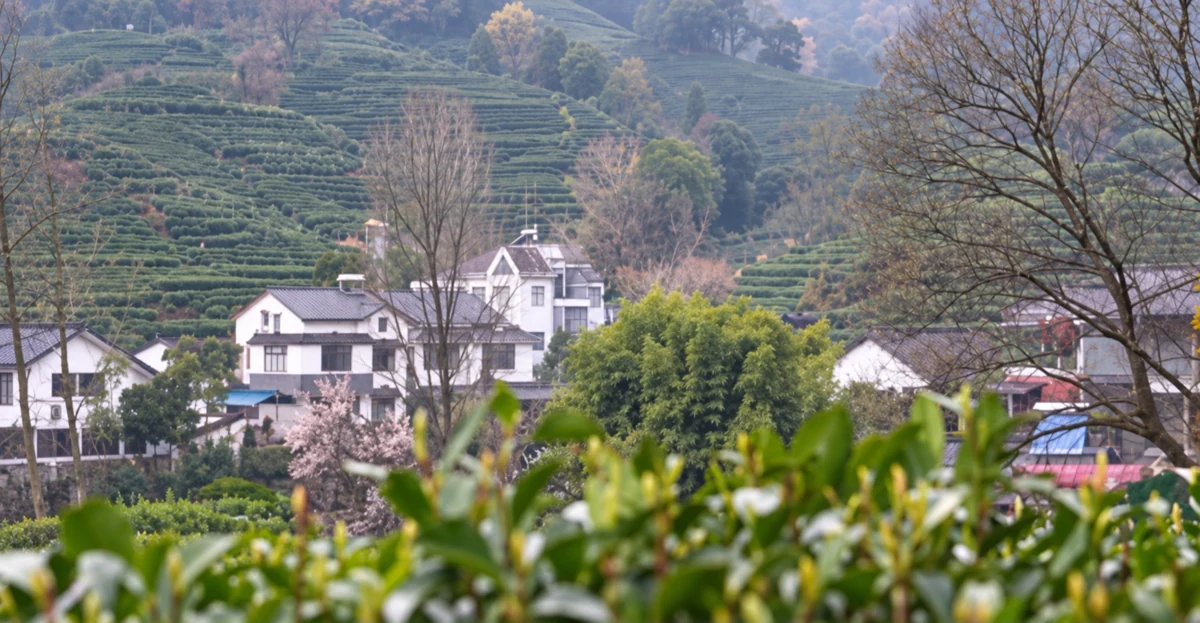
The original report also describes additional grower traceability information, including tea-plot mapping and a quality-and-safety commitment certificate. Where these records are available, compare them with the producer’s account. A tea-garden photograph or a map by itself does not connect a specific bag of leaves to that place.
3. Cross-check the seller, origin and harvest claims
Ask for the actual producer, the harvest year and a precise origin description. “Hangzhou tea,” “Zhejiang green tea” and “Dragonwell-style” do not establish West Lake origin. A business based in Hangzhou can sell tea grown elsewhere.
For tea sold under an authorized company’s name, compare the producer with the association’s current authorization information. A shop may be a reseller rather than the producer; ask it to explain that relationship. Keep the product listing and receipt, and make sure they describe the tea you ordered.
Shifeng Longjing and Meijiawu Longjing are more specific origin claims within the West Lake context. They need more specific supporting information, not just a higher price or a famous place name printed on a gift box.
Harvest and processing terms answer different questions:
- Mingqian Longjing, Pre-Ming or pre-Qingming Dragonwell: a claim about picking before Qingming in the stated year; it does not independently prove West Lake origin.
- First flush Longjing: ask what the seller means by “first”—the first picking of a particular garden, cultivar or batch. It is not a complete origin certificate.
- Hand pan-fired Longjing: a processing claim. Ask which stages were done by hand if that is important to you; handwork does not identify the growing area.
Five questions to ask before ordering
- Is this West Lake Longjing, or Longjing from another production area?
- Who produced this batch, and what harvest year and picking period are stated?
- Can I see the actual package label and verify the code after delivery?
- If the tea is repacked, what traceability connects this pack to the original batch?
- Can I buy a small sample, and what is the return policy if the delivered product differs from the listing?
A very low price is a reason to ask more questions; a high price is not proof. If origin information, packaging and verification results conflict, pause the purchase and ask for clarification. You do not need to diagnose a fake from a photograph.
Common questions
Is Dragonwell tea the same as West Lake Longjing?
Dragonwell is an English name for Longjing. It does not automatically mean West Lake Longjing. Read the specific production-area claim.
Can I identify genuine West Lake Longjing by taste?
Taste helps assess a tea’s character and condition. Similar leaf styles and aromas occur beyond one origin, so taste alone is not reliable evidence of where the tea was grown.
Does Mingqian mean a tea is better?
It describes harvest timing. Your preference also depends on the actual batch, processing, storage and brewing. It is not a substitute for checking origin.
Continue with the Longjing tea guide and article collection, or compare Longjing with other teas in our Chinese green tea types guide.
Reporting reference: the association’s March 19, 2026 spring-harvest report. Images follow the supplied document’s order. The two photographic frames have been cleaned and clarified for illustration; the security-label examples retain their original printed details.