Tea & Teaware Guides
Imperial Porcelain: Kangxi, Yongzheng and Qianlong

Imperial porcelain is porcelain made for the Chinese imperial court. At Jingdezhen, in Jiangxi province, court commissions gave potters both demanding instructions and room to experiment. During the Kangxi, Yongzheng and Qianlong reigns, that combination produced brilliant blue-and-white painting, delicate enamels and red glazes that still stop visitors in front of museum cases.
The easiest way to appreciate these wares is to look at what each technique does: how blue moves from a dark outline to a pale wash, how a flower acquires depth through enamel shading, or how a single red glaze changes from the shoulder of a vase to its foot. This guide follows those details across three Qing reigns.
About the photographs: the supplied images illustrate forms and decoration. Their filenames and inscriptions do not establish age or imperial provenance. Chinese overlays are translated in the relevant captions; cleaned images are identified. The featured floral vase was labeled Qianlong in the source material, but that attribution has not been independently verified.
What makes porcelain imperial?
An imperial connection describes who commissioned or used an object, rather than a color, shape or quality grade. A blue-and-white bowl could belong to a court service, a private household or an export shipment. Jingdezhen produced for all of those markets, so the place name alone does not establish court use. For that distinction, see what Jingdezhen means on a porcelain or teaware listing.
Court production involved more than a kiln. Officials, model makers, painters and specialized craftsmen worked within an organized system, and emperors could intervene in designs and execution. The Metropolitan Museum of Art’s overview of Qing court decorative arts describes this active patronage, alongside the court’s interest in older Chinese forms and European imagery.
Kangxi, Yongzheng and Qianlong at a glance
| Reign | Dates | Useful starting points for looking |
|---|---|---|
| Kangxi | 1662–1722 | Luminous cobalt painting, bold wucai enamels and renewed copper-red glaze experiments |
| Yongzheng | 1723–1735 | Carefully balanced shapes, refined painted enamels and attentive interpretations of earlier porcelain |
| Qianlong | 1736–1795 | Elaborate decorative programs, archaic references and ambitious combinations of techniques |
These are broad tendencies, not a dating checklist. A restrained Qianlong bowl and a densely decorated Yongzheng vase can both fit within their periods. Designs also continued from one reign into the next. Compare individual objects rather than treating each emperor’s name as a fixed visual formula.
Blue-and-white porcelain: one color, many effects
Blue-and-white porcelain, or qinghua, uses cobalt decoration beneath a transparent glaze. A painter can vary the density of the blue through brushwork and washes; firing then becomes part of the result. The V&A’s guide to Chinese blue-and-white ceramics explains the technique and the tonal effects associated with Kangxi painting. Our guide to Jingdezhen blue-and-white teaware introduces the same vocabulary on tea utensils.
The Shunzhi background
The Shunzhi reign, 1644–1661, provides useful context for the three reigns that followed. The supplied Chinese article describes transitional blue-and-white wares with landscapes, flowers, birds and literary subjects, often associated with private kilns. Court orders existed, but an early Qing object should not automatically be labeled imperial.
On the lidded jar below, the interest lies in the way flowers, rockwork and a bird occupy the rounded surface. Follow the painting around the body: a ceramic vessel gives the artist a changing field of view, unlike a flat sheet of paper.

Kangxi: the range within cobalt blue
In accomplished Kangxi blue-and-white painting, dark outlines, medium tones and lighter washes can coexist without losing clarity. Older Chinese descriptions sometimes speak of blue divided into several shades. That means expressive tonal range, rather than five separate blue pigments.
The source article also describes the court’s flower-and-poem cups representing the months of the year. They bring painting, poetry and the small scale of a drinking vessel together. That is a useful reminder that court porcelain was not confined to imposing display vases.
Yongzheng: proportion and reinterpretation
Yongzheng porcelain is often appreciated for the relationship between its shape and its decoration. Look at the transition from shoulder to neck, the balance of handles, and the amount of white surface left around a painted scene. Refinement can come from those decisions as much as from the number of brushstrokes.
The reign also revisited earlier Ming designs, including forms associated with the Yongle and Xuande courts. These were interpretations made for a new patron. A deliberate reference to an older vase does not make the newer work an object of that earlier period.

Qianlong: decoration organized across a vessel
Qianlong blue-and-white production continued earlier models while developing elaborate arrangements of borders, floral scrolls and other motifs. The featured vase offers a way to study this organization: compare the ornament around its mouth, along the neck, across the rounded body and near the foot. Each band helps the eye read a different part of the shape.
More ornament is not automatically better craftsmanship. Ask whether the bands relate to the form, whether the brushwork stays controlled around curves, and whether the overall design holds together from a few steps away.
Painted enamels: wucai, famille rose, falangcai and doucai
The original article devotes considerable space to colored decoration. Its central point is worth keeping: Qing painters had several technical routes to color, and those routes should not be collapsed into a single label.
Wucai and famille rose
Wucai, conventionally translated as “five colors,” is not a promise that an object uses exactly five pigments. Kangxi examples can have vivid red, green and yellow, with blue, black or gold contributing to the painting. Look for strong outlines and lively contrasts.
Fencai, often discussed under the European term famille rose, uses a palette that allows soft shading and subtle transitions, including opaque colors. It became especially important under Yongzheng and continued under Qianlong. A flower petal can change tone within its own outline, creating a different effect from a flat area of strong color.
Continuity matters here. The Met’s Qianlong-mark-and-period vase with nine peaches follows a design developed during the preceding Yongzheng reign. A motif may tell you about court taste without identifying one reign on its own.
Falangcai and yangcai: workshop context matters
Falangcai refers to painted enamels on porcelain associated with the Qing palace workshops. Jingdezhen could supply the glazed porcelain body, with enamel painting and its firing completed in Beijing. A Qianlong vase in the British Museum’s collection is catalogued with precisely that division of production.
The source text distinguishes this palace practice from yangcai, a term used in court records for porcelain drawing on Western-style enamel painting, including works completed at Jingdezhen. Modern usage of yangcai and fencai is not always consistent. Shared enamel colors alone do not prove that two objects followed the same workshop process.
Poems, painted flowers, landscapes and small seal-like inscriptions could turn a vessel into a carefully arranged composition. Read those elements together. Their placement on the curved surface is part of the design.
Doucai: decoration below and above the glaze
Doucai combines underglaze blue with colors added over the glaze. Qing potters revisited celebrated Ming designs while using their own enamel palettes. The British Museum’s Qianlong-period chicken cup is a documented example of a later interpretation of an earlier design.
Three red glazes that deserve separate names
“Red porcelain” covers very different materials and firing methods. Langyao red, peachbloom and gold-based rouge red are especially helpful comparisons because their visual effects and technical histories differ.
Langyao red: copper, depth and glaze movement
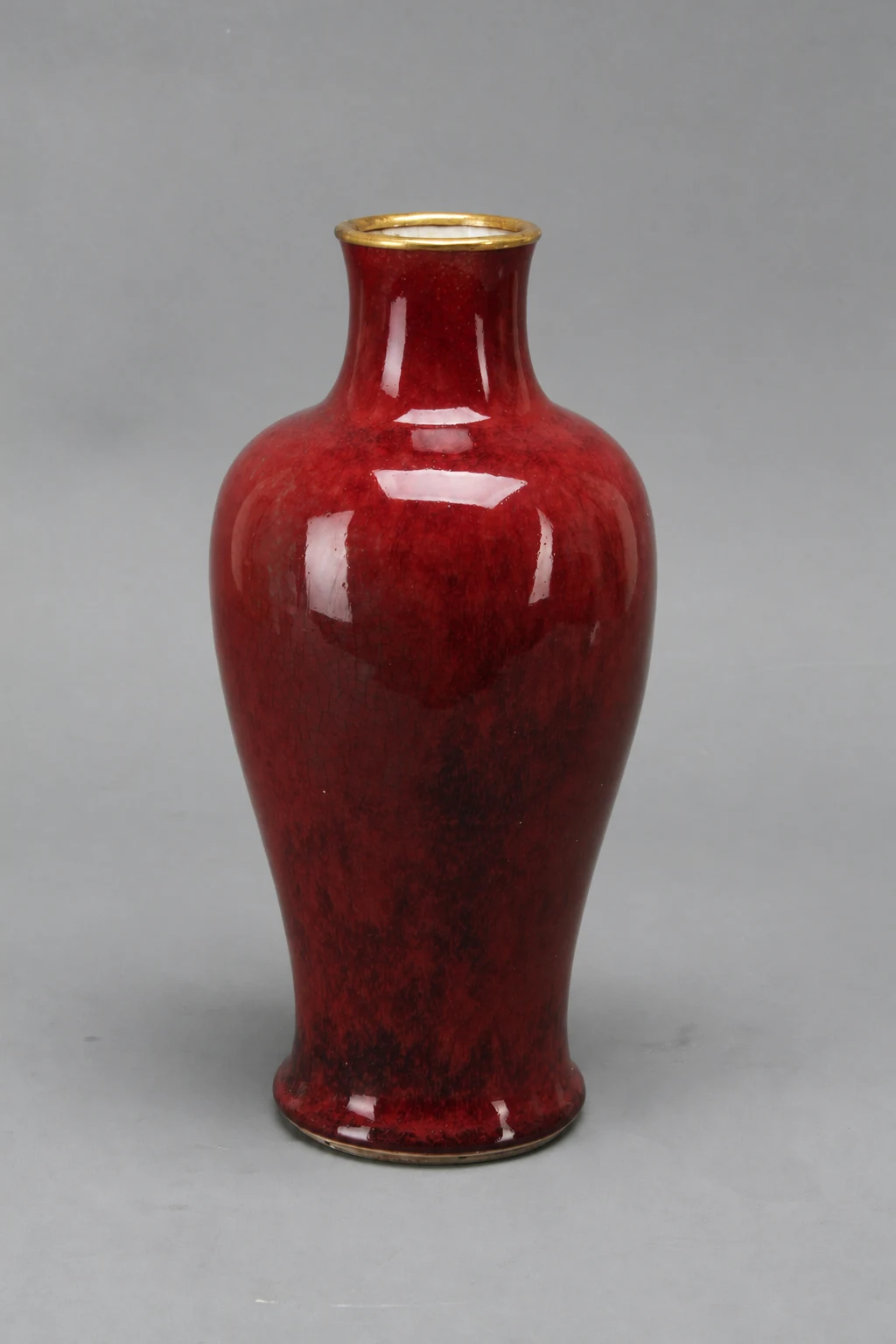
Langyao red is a high-fired copper-red glaze associated with the Kangxi era and named for the official Lang Tingji. Copper-red firing requires close control of the kiln atmosphere. The University of Michigan Museum of Art’s Langyao vase record explains that relationship between copper color and reducing conditions.
The Palace Museum’s Langyao-red meiping record describes a thick glaze, visible crackle and darker accumulation toward the lower body. Those changes are part of the glaze’s character. A photograph can help you notice them, but crackle or a pale rim is not, by itself, evidence of age.
Peachbloom: mottling on small scholar’s objects
Peachbloom, called jiangdouhong in Chinese, is another high-fired copper-red glaze associated with late Kangxi imperial production. Its soft reds can be interrupted by green mottling. The National Museum of China’s peachbloom group includes a brush washer, seal-paste box and small vessels belonging to the scholar’s desk tradition.
Scale matters. The supplied photograph below was labeled peachbloom, yet its overlay states a height of 37.8 cm—about 14.9 inches. That is substantially larger than the familiar small Kangxi scholar’s objects discussed in the source and museum record. We use it to illustrate visible red-and-green variation, not as an authenticated example of that imperial group.

Rouge red: color produced with gold
Gold-based red, often called rouge red or yanzhihong, is a lower-temperature glaze or enamel technology distinct from high-fired copper red. “Gold” identifies the colorant; it does not mean a metallic gold surface. The Palace Museum’s rouge-red dish record describes a red glaze colored with a minute amount of gold and fired at roughly 800°C, or 1,470°F.
The color can range through pink and deeper rouge tones. It appeared in the late Kangxi period and became prominent under Yongzheng. The meiping below gives a visual comparison with the copper-red photographs, although its source inscription has not been checked against the object.

Qianlong ingenuity and the people behind it
Court porcelain also gave craftsmen opportunities to imitate other materials and develop complex structures. A vessel might resemble bronze or incorporate moving parts. These objects reward a second look: the surprise comes from what fired clay has been made to do.
Tang Ying was an important figure in this work. Sent to Jingdezhen in 1728, he helped connect court requirements with practical kiln knowledge. The Palace Museum’s biographical entry on Tang Ying records his involvement in both technical research and the adaptation of earlier wares.
For a documented example of combined techniques, look at the Palace Museum’s Qianlong large vase with multiple glazes and enamels, often nicknamed the “mother of porcelain.” Its different high- and low-temperature surfaces bring together several demanding processes. It shows why a single word such as “painted” can be inadequate for describing a court ceramic.
How to look at imperial porcelain in a museum
Start with the silhouette, then move to the surface. Notice the mouth, the shoulder and the way the body meets the foot. In blue-and-white painting, compare washes with outlines. In enamels, follow shading within a petal or robe. In monochrome glazes, look at changes in depth, pooling and reflected light.
Next read the catalogue wording. “Mark and period” conveys a different attribution from “bearing a reign mark,” “in the style of,” or “later copy.” A reign name alone is not a date: the British Museum’s Qianlong-period chicken cup mentioned above bears an earlier Chenghua mark. An inscription can be part of a reference to the past.
Imperial porcelain is most rewarding when those observations stay connected. A finely judged shape, a particular painting method and a documented court context together tell a richer story than a reign name or a bright glaze considered alone.
Questions readers often ask
Is all Qing porcelain imperial?
No. Qing-period porcelain includes court commissions, private-kiln wares and export production. An imperial attribution needs object-specific evidence.
Is peachbloom the same as rouge red?
No. Peachbloom belongs to the high-fired copper-red tradition; rouge red uses gold as a colorant in a lower-temperature process. Similar-looking red tones can have different technical origins.
Can a Yongzheng or Qianlong mark prove the date?
No. Marks can be copied or used as references to earlier wares. Read the complete museum or specialist attribution rather than relying on the inscription alone.
Editorial source: adapted and reorganized from the supplied Chinese article attributed to Lu Chenglong of the Palace Museum. Museum collection records are linked alongside the relevant discussion. The supplied photographs are illustrative and have not been independently authenticated.