Tea & Teaware Guides
Yixing Teapot Decoration: 10 Techniques Explained

Yixing teapot decoration can be as quiet as a few carved characters or as elaborate as a pierced outer wall filled with sculpted figures. Some patterns are added to the surface. Others come from contrasting clays, cut lines or the way the pot is fired.
That variety is part of the pottery tradition of Yixing in Jiangsu, China. The city’s account of Yixing zisha craftsmanship places decoration alongside material preparation, forming and firing, and describes its connections with poetry, calligraphy, painting and seals.
This guide explains eight decorative categories and two firing effects. The useful starting point is simple: look at what creates the pattern, rather than judging by colour alone. A Chinese Yixing teapot may combine several methods on the same body, lid and handle.
1. Ni Hui: painting with clay
Ni hui uses fine clay slip to make pictures or lettering on the vessel. The material may match the body or introduce contrasting colours. As it is built up and shaped, the design can stand slightly proud of the surface, closer to low relief than a flat layer of paint.
In the bird-and-lotus example above, the colour and raised detail work together. Look at the edges of the leaves and the modelling of the seed pod. These are useful visual clues when comparing clay painting with a design simply painted onto a finished surface.
Brushes are only part of the toolkit. A Xi’an Academy of Fine Arts account of a ni hui workshop describes artists using shaping tools as well as brushes, and working on the compatibility and attachment of the applied clay.
2. Tao Ke: incised calligraphy and pictures
Tao ke brings drawing and writing into the clay through carving. It is commonly carried out before the pot is fired. The depth, direction and edges of the cuts give the lines a character that differs from brush-applied decoration.
A carved design might be a poem, a landscape or a few expressive strokes. Some approaches leave recessed lines; others remove surrounding clay so that parts of a design stand higher. Work can also combine carving with colour.
The inscription’s role matters as much as its style. Decorative writing is not automatically the maker’s signature. For reading the different kinds of marks, see our Yixing teapot seals and calligraphy guide.

3. Jiao Ni: marbled clay
Jiao ni creates patterns by combining differently coloured clays while keeping their colours distinct. Layers can be pressed, folded or arranged into flowing bands. Fully blending them would lose the contrast that makes the marbling visible.
The result may resemble wood grain, rippling water or a woven pattern. The rectangular vessel shown here has long, flowing bands that emphasise its upright sides. This is a different idea from painting imitation wood grain onto the outside.
Marbling describes a decorative approach, not a specific clay formula. When comparing examples, look at how the pattern turns around the form and how it relates to the lid, spout and handle.

4. Tie Hua: applied clay relief
Here, tie hua means attaching clay motifs to the vessel. It should be translated as applied clay decoration or appliqué, rather than a printed ceramic transfer decal.
Small flowers, leaves, branches or other forms are shaped and joined to the unfired body, typically with suitable clay slip at the joins. The added elements may share the body’s colour or introduce a contrast.
On naturalistic designs, the decoration can extend across the body and become part of a handle or lid knob. The difference from ni hui is one of emphasis: applied relief builds with formed pieces, while clay painting builds an image through slip application and modelling. A single pot can use both.

5. Inlay: contrasting material set into the surface
Metal inlay
In a typical wire-inlay method, channels are prepared in the clay design, and metal is fitted into them after the ceramic body has been fired. The metal is then worked and finished to create the intended lines or pattern.
Inlay is different from applying gold-coloured decoration over the surface. Golden-looking lines can be difficult to identify from a photograph, so the maker’s material and process description is useful. Our miao jin and gilding guide explains that separate family of techniques.

Clay inlay
Clay inlay uses contrasting clay in prepared recesses or patterns before firing. Rather than layering a complete picture above the body, it sets the contrasting material into the design.
Fine lines may form an ice-crack or crackle-like pattern. That visual effect should be distinguished from a crack in the pot itself. For an individual example, ask which material forms the lines and how the design was made.

6. Lou Diao: openwork carving
Lou diao removes sections of material to create openings in the decorative design. The spaces are part of the picture: a branch or figure is defined by what remains and by what has been cut away.
Some openwork vessels use a pierced outer layer around an inner wall that holds liquid. The outer shell can carry intricate scenes without opening directly into the brewing chamber. Construction varies, so an interior view is needed to understand how a particular piece works.
The example below combines pierced areas, relief carving and bird-shaped fittings. Take time to look at the narrow bridges of clay between the openings; they help explain the care required in making and handling such detailed work.

7. Dian Cai: raised, point-applied colour
Dian cai refers here to building a coloured design through small applications of ceramic colour or enamel material. The applications can join into flowers, foliage and other raised motifs rather than remain as isolated dots.
This belongs to a different material family from painting with clay slip. Coloured ceramic decoration may involve an additional firing appropriate to the material used. It is better to ask about the actual enamel or glaze process than assume one temperature or firing sequence applies to every example.
In the small blue-floral detail, the raised pattern catches light differently from the brown surface beneath it. That contrast is the feature to notice; a photograph cannot identify the precise recipe.

8. Pu Sha: contrasting surface granules
Pu sha places contrasting prepared granules onto the surface while the clay body is still receptive to them. The particles are worked into the outer layer, giving the fired surface a speckled appearance.
This differs from mixing particles throughout a clay body, often discussed as tiao sha. One concentrates the decorative effect at the surface; the other concerns the body mixture. The materials need to work together through drying and firing.
The close-up below shows the visual appeal of pale granules against a darker ground. Those speckles are a surface feature, rather than a reliable way to identify the clay’s source or prove how the whole pot was formed.
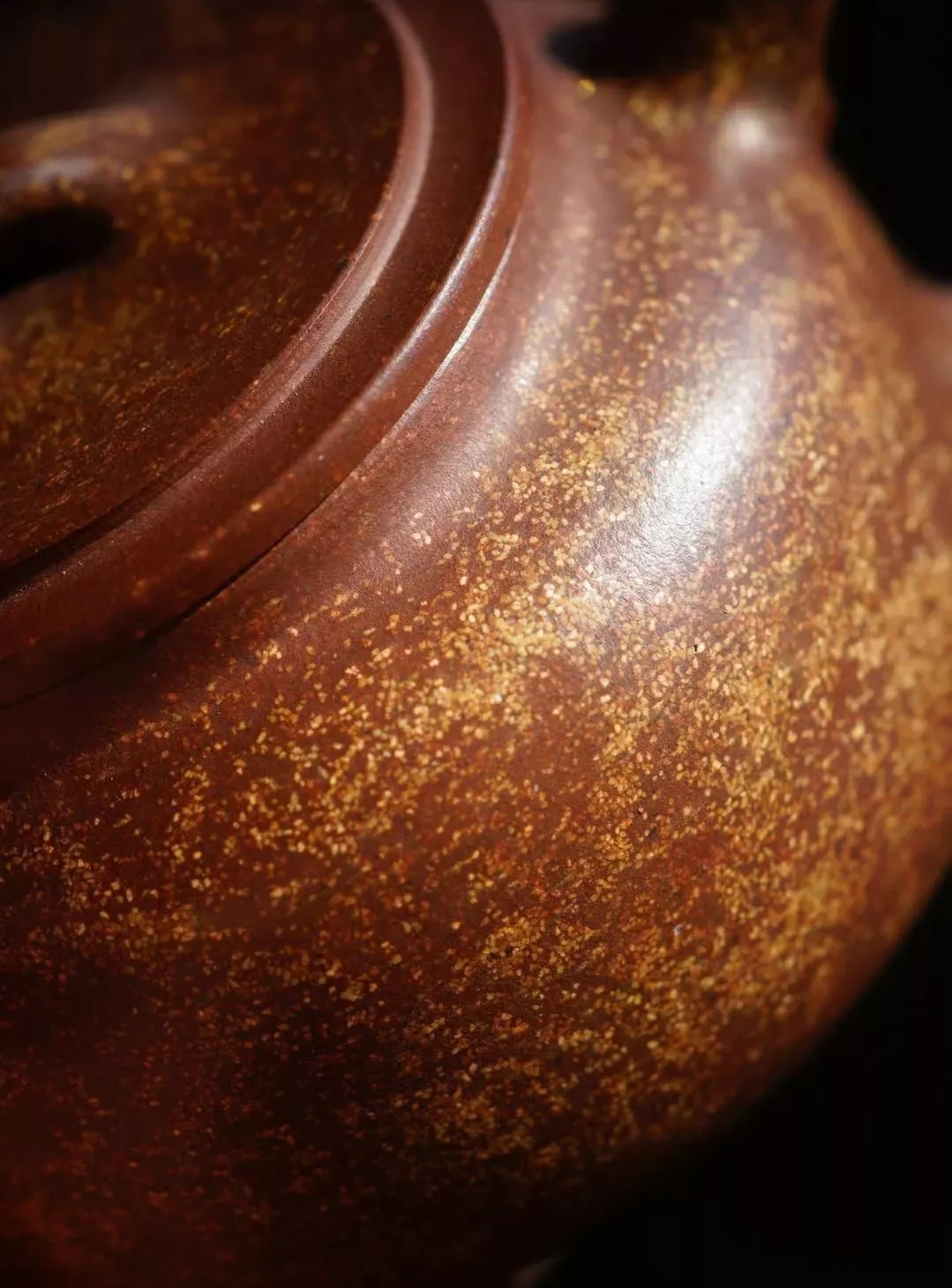
9. Wu Hui: darkening through firing conditions
Wu hui is a darkening treatment associated with an oxygen-limited, carbon-rich firing environment. It is a process description, rather than the name of a particular black clay.
Atmosphere can change the colour of iron-bearing ceramics. Digitalfire’s explanation of reduction firing describes how reduced oxygen availability affects ceramic materials. The precise result still depends on the body and the maker’s firing schedule.
The dark pot below illustrates the appearance discussed in this section. An even black or grey colour alone does not establish that wu hui was used; other materials and finishes can also produce dark surfaces.

10. Yao Bian: kiln-created colour variation
Yao bian is used for colour and surface changes associated with firing. On a zisha body, variations in the material, heat and atmosphere can contribute to a mottled or uneven appearance.
It is misleading to explain every example as a change in “glaze colour.” A glaze and an unglazed ceramic body are different surfaces, and the maker should be able to say which is present. Nor does kiln variation have to be entirely accidental: potters can deliberately explore firing conditions while leaving room for variation.
The brown-and-ochre pot shown here illustrates that variegated look. Its appearance does not, by itself, tell us the firing history, date or rarity.

A quick way to read the decoration
| What you notice | Where to start |
|---|---|
| A raised clay picture or motif | Ni hui or applied clay relief |
| Cut lines or carved writing | Tao ke |
| Flowing bands of different clay colours | Jiao ni |
| Material set into a design | Metal or clay inlay |
| Openings forming part of a scene | Lou diao |
| A darkened or mottled body | Ask about the clay, surface treatment and firing conditions |
These categories overlap. A Chinese tea pot can carry carving, applied relief and coloured details together. The photographs illustrate visual features; identifying a particular piece’s materials, maker or firing history takes more than its appearance.
Choosing and caring for a decorated pot
For a pot you plan to use regularly, consider how the decoration feels around the handle and lid, whether the opening is easy to reach and how you will rinse the detailed areas. Fine projections and pierced sections deserve gentle handling.
Follow the maker’s care instructions for the finish. Avoid treating metal, fired colour and plain clay as though they all need the same polishing routine. Our daily cleaning guide covers the basic care of Yixing pots.
Decoration also tells a different story from forming. An elaborate surface does not establish that the body was made entirely by hand. If that distinction matters to you, read our guide to Yixing teapot making methods alongside this overview.