Tea & Teaware Guides
Yixing Teapot Shapes: 10 Practical Trade-Offs

Choosing between Yixing teapot shapes gets easier when you picture an ordinary tea session: adding leaves, filling the pot, pouring into a pitcher and getting the wet leaves out afterward. A shape you love in a photograph may feel quite different in your hand.
These clay teapots come from Yixing in Jiangsu, China. The Chinese national intangible cultural heritage record describes round, angular, ribbed and naturalistic forms within the tradition. Within those broad groups, individual designs offer different combinations of access, balance and detail. Read the heritage overview of Yixing zisha pottery.
This guide looks at the everyday compromises of ten familiar shapes or shape families. For names, silhouettes and a wider range of examples, start with our illustrated guide to 55 Yixing teapot forms.
A shape is a starting point, not a performance guarantee. A straight spout does not automatically dribble, a curved spout does not guarantee a clean stop, and a square body does not mean a leaking lid. Judge the particular pot: its spout, outlet holes, air vent, lid fit and balance all deserve a look.
1. Xishi: check the short spout in use
A Xishi typically has a rounded body, a domed lid and a short spout. Its compact outline can be comfortable on a small tea tray. The useful question is how that particular spout behaves as you tilt the pot and return it upright.
What to watch: water may track under the lip on some examples, especially when the pot is overfilled or poured very slowly. That is a reason to check the lip and pouring angle, not to dismiss every Xishi. Ask for a continuous water-pouring video, including the moment the pour stops.
Before choosing: check that the handle gives your fingers room and that you can steady the lid comfortably. A charming outline is only part of the decision.
2. ShiPiao, including Ziye variants: opening size matters
The ShiPiao family includes different body proportions. Many Ziye variants have a pronounced angular profile, while other ShiPiao pots are fuller. Do not assume that all of them have the same opening or handling characteristics.
What to watch: a relatively small mouth can make it awkward to load long, wiry leaves or remove a tightly packed mass of spent tea. A broad body with a narrower opening may also take more care to rinse. The straight spout itself is not proof of poor flow or an untidy cutoff.
Before choosing: look at an open-lid photograph, compare the opening with the leaves you actually use, and watch a normal pour. A dark tea trail beneath a spout is not a reliable way to identify a whole shape family’s performance.

3. Fanggu: a low body needs a comfortable grip
A Fanggu usually combines a low, rounded body with a broad lid and curved spout. That low profile is part of its appeal. It also makes the relationship between the lid knob, handle and body worth checking carefully.
What to watch: can you hold the handle without crowding the body, and steady the lid without stretching? A wide lid may be convenient for leaves, but the knob still needs to be easy to hold. Those details vary between makers and sizes.
Before choosing: look for a steady, controlled stream and a comfortable pouring angle. The height of the water’s arc is not a useful stand-in for brewing quality. See our Fanggu teapot guide for a closer look at this form.

4. Hanwa: broad access, but inspect the lid
The Hanwa examples shown here have cylindrical bodies and broad lids. If you regularly struggle to remove spent leaves from a small opening, this is a feature worth considering. You can also see more of the interior when checking the pot.
What to watch: a broad lid is still a separate clay piece. Check how securely it seats and whether its knob gives you a confident grip. On a flatter lid, spilled water may remain on the surface rather than run off immediately.
Before choosing: ask for the lid to be lifted and replaced on video. Consider the pot’s overall size and filled weight alongside its opening; a wide mouth alone does not tell you how comfortable it will feel.

5. Handuo: look closely at the recessed lid seat
The tall Handuo-style example below has an inset lid and a fairly upright body. The recess around a lid is easy to overlook in a sales photograph, yet it can affect how you like to fill and rinse the pot.
What to watch: water can collect in a recessed lid seat if you splash across it. If you prefer a mostly dry tea tray, check whether you can fill neatly and wipe the rim easily. The shape does not make dry-tray brewing impossible.
Before choosing: inspect the lid removed, then seated. If you skim foam from the opening, consider whether the rim gives your usual tool enough room. Do not assume every Handuo has an identical lid arrangement.

6. Pear-shaped pots: protect the projecting spout
Pear-shaped pots have a rounded lower body that narrows toward the top; proportions and spout designs vary. Si Ting is often discussed alongside pear-shaped forms. Dezhong, with its distinct cylindrical profile, should not simply be treated as another name for a pear-shaped pot.
What to watch: on an example with a slender, projecting spout, leave clearance when moving cups or rinsing the pot. A narrow opening may also be less convenient for large leaves. Neither the silhouette nor a curved spout guarantees a particular aroma or pouring result.
Before choosing: confirm the actual capacity. Pear-shaped pots are not defined by a universal 150 mL limit. Choose the volume for your cups and number of drinkers, then check the grip and pour.

7. ShuiPing: leave room around the spout
The ShuiPing example here combines a round body, a circular handle and a relatively long spout. The outline may look compact until you account for the spout and handle together.
What to watch: a projecting spout can be easy to knock against a pitcher, sink or nearby pot. If your brewing area is crowded, compare the pot’s total length with the clear space on your tray.
Before choosing: check the handle opening, filled balance and actual capacity. A larger version is not automatically a bad design; judge how its proportions and weight work for you. Avoid dramatic balancing tricks as a substitute for a straightforward pouring demonstration.

8. Gongchun-style pots: texture adds cleaning work
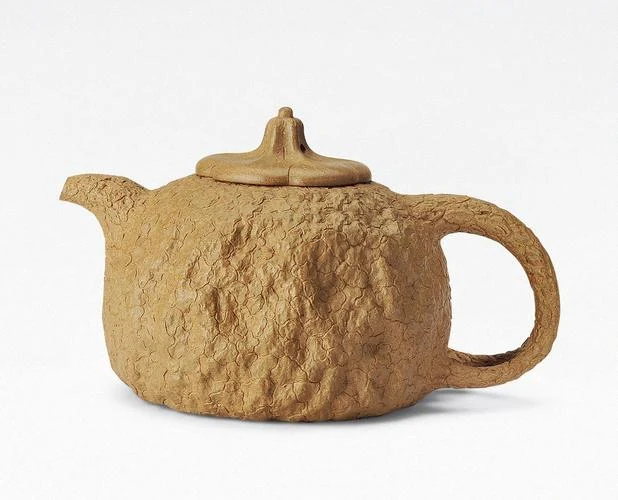
A Gongchun-style pot brings a bark-like, irregular surface to the table. Here, “Gongchun-style” describes the visual tradition. It does not identify the maker or date of the photographed pot.
What to watch: exterior crevices give splashed tea and dust more places to settle than a smooth surface does. If you want a pot that is quick to rinse and dry, consider how much surface texture you are happy to maintain.
Before choosing: look for access around the lid and handle as well as the textured body. Rinse carefully and let the pot dry thoroughly. There is no need to build up tea residue to make the surface look aged, or to scrub delicate details aggressively.
9. Tiliang: check clearance beneath the overhead handle
Tiliang refers to an overhead-handle form, with many interpretations of the handle and body. It can be a useful brewing pot as well as an expressive object; the handle’s position simply asks for a different handling check.
What to watch: the handle may limit the angle at which you lift the lid, add leaves or approach with a kettle. A tall sculptural handle can also need extra storage space.
Before choosing: watch someone remove the lid, refill the pot and pour it. Check for a stable grip and manageable balance when filled. Price and usability cannot be inferred from an overhead handle alone, and these pots do not all need to be reserved for display.

10. Square and ribbed forms: inspect the joins and lid alignment
Square and ribbed pots are different design groups, but both reward a close look at how the lid relates to the body. Square forms emphasize planes and corners; ribbed forms repeat lobes around the pot.
What to watch: corners may take extra attention when rinsing out leaves. A matching lobed lid may seat in specific orientations, so check how readily you can replace it during brewing. Those details do not mean that every square or ribbed pot leaks.
Before choosing: ask for open-lid views and a normal pouring demonstration. The outside shape does not determine whether the internal outlet holes are square or round. Check the actual filter arrangement rather than relying on sayings about “leaky” shape families.

How to choose between Yixing teapot shapes
Start with the part of brewing that you most want to make easier. Use these features to shortlist a pot, then inspect the individual example.
| Your priority | Feature to look for |
|---|---|
| Easy loading and cleaning | An opening that suits your leaves and gives access to the interior |
| A crowded tea tray | Enough clearance around the whole pot, including its spout and handle |
| A mostly dry brewing area | A controlled pour, a well-seated lid and a rim you can wipe easily |
| Quick daily care | Accessible surfaces and details you can rinse and dry without fuss |
When buying a Chinese Yixing teapot online, request a few useful views: the lid off, the inside outlet holes, the handle in someone’s hand and a continuous water pour that includes the stop. A short demonstration answers more practical questions than a dramatic stream alone.
If this will be your first Chinese tea pot, choose a capacity that matches your cups before getting attached to a silhouette. You do not need the most elaborate form. You need one that makes sense for the tea you drink, the space you have and the way you like to brew.