Tea & Teaware Guides
Teapot Shape Guide: 55 Yixing Forms in Pictures

Yixing teapot body types fall into four useful families: round, angular, naturalistic and ribbed. This guide shows 55 named shapes in pictures, including Xishi, Shipiao and Fanggu. Use the comparison table and jump links to identify a silhouette, then compare the lid, spout and handle.
A Chinese Yixing teapot belongs to the zisha pottery tradition of Yixing, Jiangsu, China. Learning its form vocabulary makes a Chinese tea pot easier to describe and compare. Start with the silhouette, then examine the lid, shoulder and fittings. The English descriptions below explain the visual idea; the romanized names help you recognize labels used by makers and sellers.
These photographs illustrate shape families. Individual makers interpret them differently, and a form name does not authenticate a pot’s clay, maker or age. Artistic inscriptions and seal details shown in the photographs belong to the objects illustrated.
The four main Yixing teapot shape families
| Family | What to look for | Examples in this guide |
|---|---|---|
| Round forms — yuanqi | Circles, cylinders, domes and other curved geometric volumes. | Xishi, Duoqiu, Jinglan, Hanwa |
| Angular forms — fangqi | Flat planes, corners and coordinated polygonal fittings. This family includes more than square bodies. | Yaming Sifang, Xuehua |
| Naturalistic forms — huaqi | Modeled plants, animals or everyday objects. Huaqi describes the sculptural approach, not a particular molding method. | Gongchun, Nangua, Zhuduan, Yinbao |
| Ribbed forms — jinwenqi | Repeated lobes or ribs coordinated across the body, lid and sometimes the knob. | Heling |
These are useful viewing categories, and a design can combine them. A pumpkin pot, for example, is both naturalistic and lobed. An overhead handle describes a fitting arrangement and can appear on different body shapes. Naturalistic Yixing design also has a long museum-documented history: see the Met’s plum-blossom-shaped Yixing teapot.
Find a familiar shape
Quick links: Xishi · Shipiao · Fanggu · Shuiping · Hanwa · Banyue / Half Moon · Gongchun.
Browse all 55 illustrated teapot shapes
- Duoqiu — Stacked Spheres
- Shipiao — Stone Ladle
- Fanggu — Classic Drum Form
- Jinglan — Well Curb
- Qinquan — Weight Form
- Hehuan — Joined Curves
- Xiaoying — Rounded Shoulders
- Sengmao — Monk's Cap
- Yangtong — Bucket Form
- Rongtian — Full-Bellied Form
- Longdan — Dragon Egg
- Dezhong — Bell Form
- Xishi — Rounded Form
- Meirenjian — Beauty's Shoulder
- Xubian — Very Low Profile
- Zhoupan — Disc Form
- Zhuchu — Column Base
- Handuo — Bell-Inspired Cylinder
- Shuiping — Balanced Round Form
- Xuehua — Snowflake Form
- Yilizhu — A Single Pearl
- Danbao — Rounded Bail-Handle Form
- Hanwa — Tile-Inspired Form
- Jizhi — Tall Cylinder
- Banwa — Half Tile
- Paogua — Gourd Form
- Hulu — Bottle Gourd
- Lianzi — Lotus Seed
- Hanbian — Flattened Round Form
- Qieduan — Eggplant Segment
- Banyue — Half Moon
- Baochun — Heralding Spring
- Zhuduan — Bamboo Segment
- Hanjun — Angular Round Form
- Yuhualong — Fish Becoming a Dragon
- Zhegu Tiliang — Partridge Bail Handle
- Yaming Sifang — Four-Sided Form
- Nangua — Pumpkin
- Siting — Pear-Like Form
- Bianfu — Flat Belly
- Bagua Longtou Yikun Zhu — Dragon and Bamboo Bundle
- Gongchun — Tree Burl
- Songshu Putao — Squirrel and Grapes
- Duozhi — Rounded Layers
- Heling — Joined Petal Form
- Gongdeng — Palace Lantern
- Dabin Ruyi — Auspicious Form
- Shangxinqiao — Bridge Form
- Tibi — Jade Disc and Bail Handle
- Julunzhu — Compact Round Form
- Huaying — Flower Bud
- Paozun — Gourd Vessel
- Yinbao — Wrapped Seal
- Tangpo — Rounded Traditional Form
- Tangyu — Side-Handle Form
55 Yixing teapot shapes: an illustrated atlas
1. Duoqiu — Stacked Spheres (掇球)
The round body, domed lid and small spherical knob create three successive curves. Duoqiu is easy to recognize by this stacked arrangement: the lid reads as a smaller rounded form resting on the larger belly. Compare the proportions rather than expecting every maker’s version to have the same height.
The featured photograph above shows this Duoqiu example.
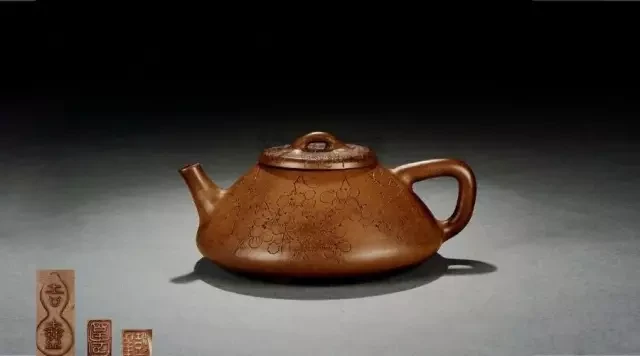
2. Shipiao — Stone Ladle (石瓢)
Look for the broad base, sloping sides and relatively narrow top. Together they give Shipiao its distinctive triangular profile. A bridge-shaped lid knob and compact spout often reinforce the spare geometry. Some examples stand on three small feet, although those feet are not equally visible from every camera angle.
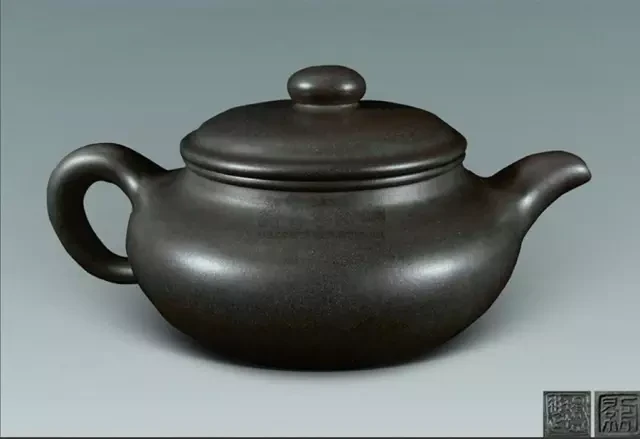
3. Fanggu — Classic Drum Form (仿古)
Fanggu combines a low, rounded belly with a broad opening and a clearly defined neck. The lid is flatter than the high dome of Duoqiu. Its appeal lies in the relationship between these horizontal layers and the curved spout and handle. For a closer comparison, read our Fanggu teapot shape guide.
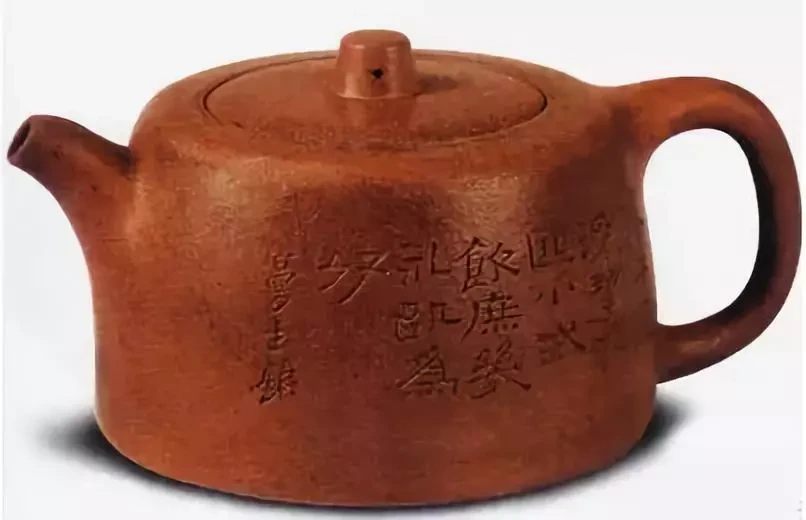
4. Jinglan — Well Curb (井栏)
Jinglan evokes the raised surround of a well. The body is a low cylinder, with nearly vertical walls and a broad circular lid. This strong, simple outline makes the shape recognizable even when the surface carries calligraphy. A well-curb form can be taller or flatter without losing its cylindrical character.
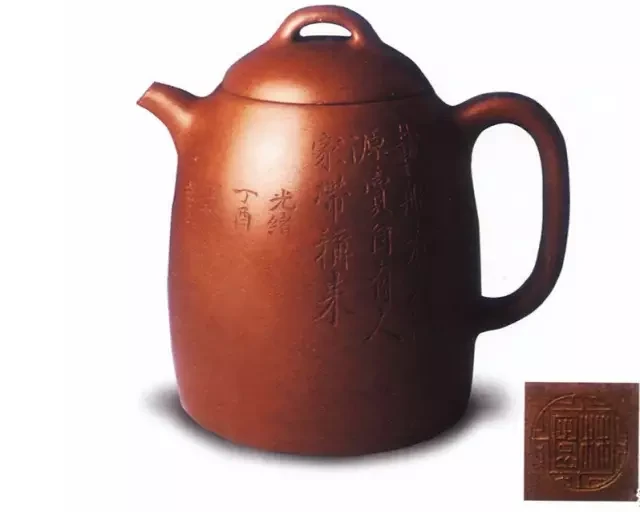
5. Qinquan — Weight Form (秦权)
Qinquan takes its name from a weighing weight. Its tall, substantial body, rounded shoulder and domed upper section give it a grounded appearance. The bridge knob in this example accentuates the vertical silhouette. Use that overall outline as the identifying clue; a weight-inspired name does not date the photographed pot to the Qin dynasty.
6. Hehuan — Joined Curves (合欢)
A broad, low body meets a gently domed lid, producing a soft, balanced outline. Hehuan is a name associated with togetherness or shared happiness. The example shown has a curved spout and a rounded handle. Its flattened body distinguishes it from the more upright, pear-like Siting or egg-shaped Longdan forms.
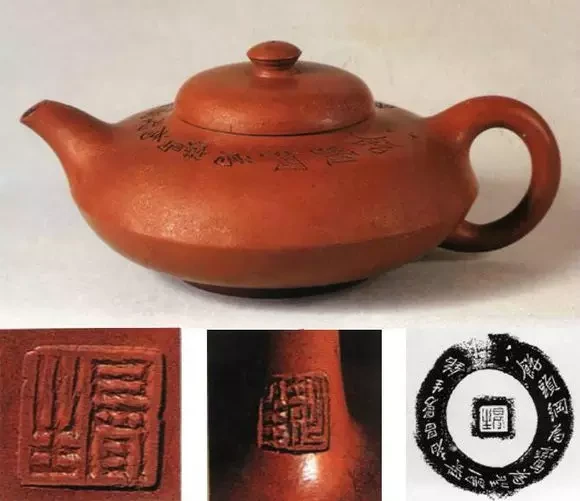
7. Xiaoying — Rounded Shoulders (笑樱)
Xiaoying usually presents a full belly, a distinct neck and a layered lid. In this example, the shoulder spreads broadly before the body narrows toward the foot. The raised handle tip and pointed knob add energy to the otherwise rounded form. The photograph offers a useful contrast with the smoother, shorter-necked Xishi.
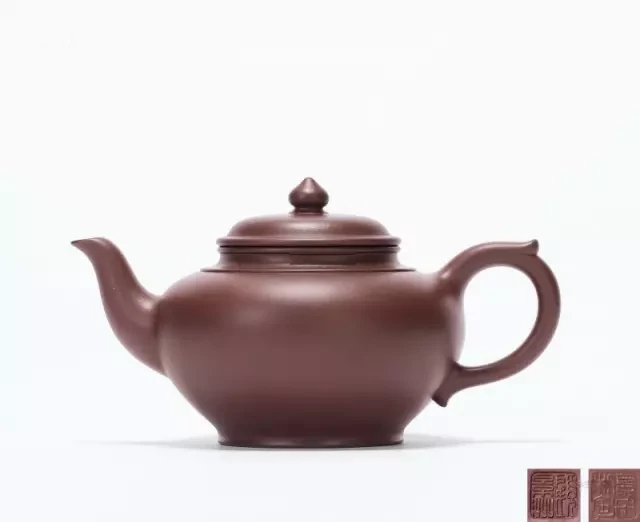
8. Sengmao — Monk's Cap (僧帽)
The raised, shaped rim around the lid is the clearest clue. Its hat-like outline gives Sengmao its name. The Palace Museum’s collection record explains that the Yixing version borrows from an earlier porcelain form. This example combines a faceted body with a curved, projecting spout.
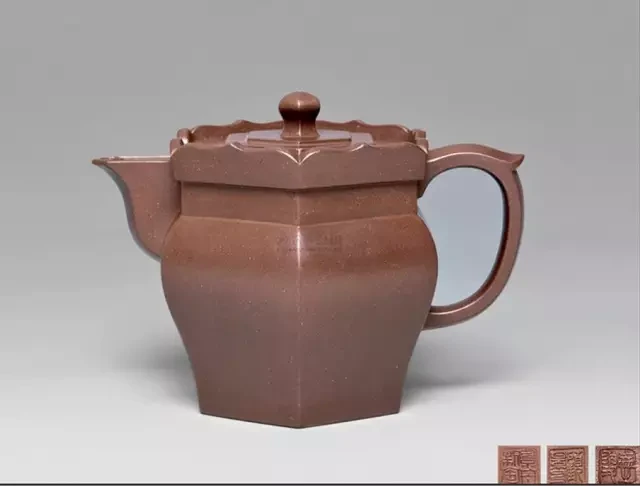
9. Yangtong — Bucket Form (洋桶)
An upright cylindrical body and a wide top give Yangtong a bucket-like profile. Many versions use a movable overhead handle. The supplied photograph shows the side mounting points but no complete bail handle, so those visible fittings should not be mistaken for a fixed side grip. The low lid completes the strong vertical body.
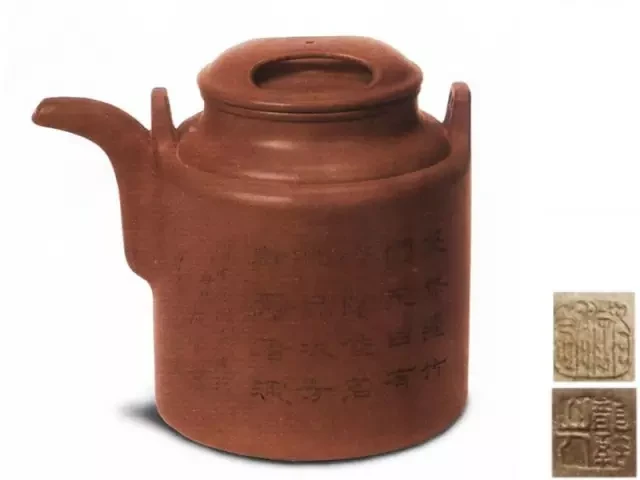
10. Rongtian — Full-Bellied Form (容天)
Rongtian is recognized by a generous belly, comparatively small upper opening and raised lid. The photographed example is low and rounded, with a short upward spout. Its concentrated neck and lid draw attention to the width of the body. Variants may differ in height, but the full-bellied outline remains a useful reference.
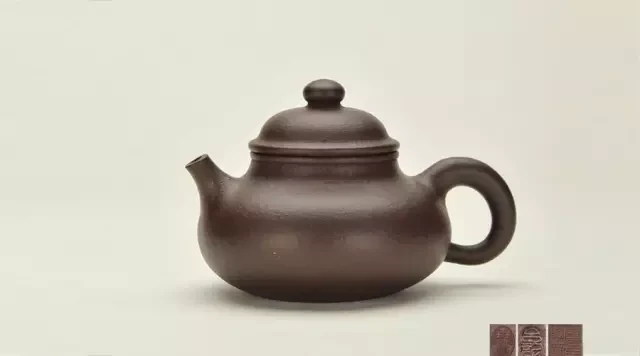
11. Longdan — Dragon Egg (龙蛋)
Longdan means dragon egg. Its body forms a continuous oval, rising into a domed lid rather than a broad, flat shoulder. A short spout and simple loop handle keep attention on that egg-like silhouette. Compare it with Siting: Longdan is fuller through the upper body and lacks Siting’s pronounced narrowing at the neck.
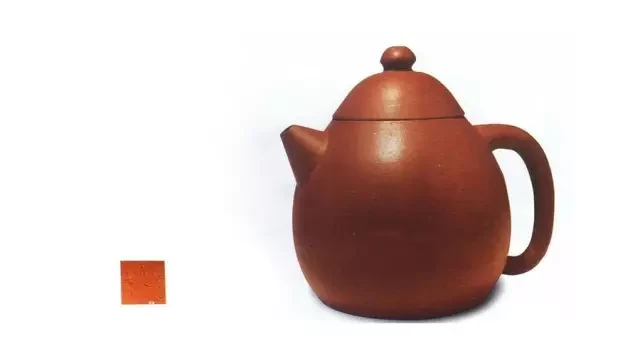
12. Dezhong — Bell Form (德钟)
Dezhong has a disciplined cylindrical body, a defined shoulder and a relatively flat lid. The example shown carries engraved calligraphy across its front. Compared with Jinglan, the lid and shoulder appear more distinctly layered. Versions vary in proportion, so examine the profile of the whole pot instead of identifying it by its knob alone.
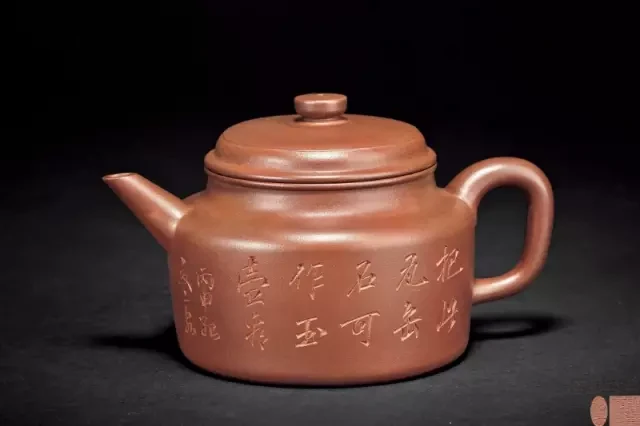
13. Xishi — Rounded Form (西施)
Xishi is one of the easiest forms to recognize: a nearly spherical body, a short spout and a rounded handle. The lid follows the body’s curve closely, creating a smooth upper silhouette. This example narrows gently near the base. Surface color and clay labels are separate questions from recognizing the Xishi shape.

14. Meirenjian — Beauty's Shoulder (美人肩)
The identifying feature is the soft transition from lid to shoulder. Meirenjian avoids the sharply stepped neck seen on Dezhong and many Fanggu examples. Its body is fuller above and narrows toward the base, giving the profile a gentle downward sweep. Look at the shoulder line first, then the proportions of the belly.

15. Xubian — Very Low Profile (虚扁)
Xubian pushes the flattened round form especially far. The body is very low and wide, while the lid stays close to the shoulder line. The photographed example emphasizes that compressed silhouette with a short spout and compact handle. A low profile describes the design; a photograph alone cannot establish how the pot was made.
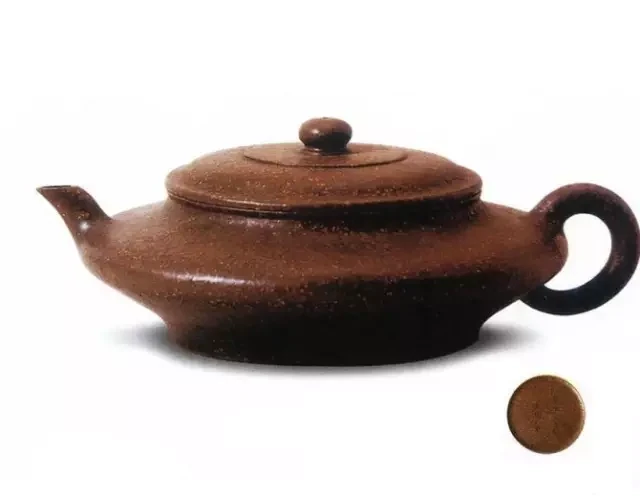
16. Zhoupan — Disc Form (周盘)
Zhoupan is a low circular form with a broad, flat lid and a short cylindrical wall. Its outline is more level and architectural than the swelling curves of a typical Fanggu. In this example, the shoulder and lower edge make crisp horizontal transitions. Engraved text decorates the body without changing its disc-like structure.
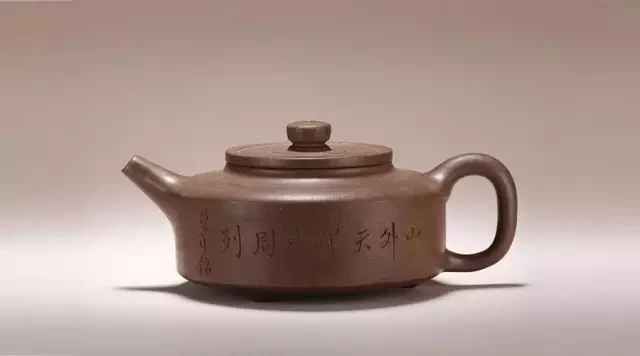
17. Zhuchu — Column Base (柱础)
Zhuchu takes its name from the stone base beneath a column. Its body spreads outward toward the lower edge before drawing back into the bottom. The flared lower profile creates a sturdy, architectural look. The photograph shows a flat lid, a compact knob and a handle whose angular turns complement the body.
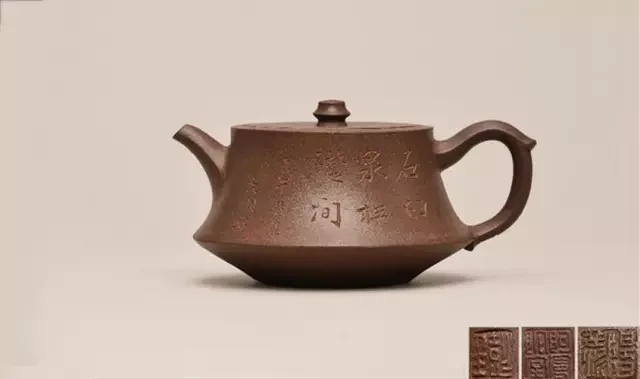
18. Handuo — Bell-Inspired Cylinder (汉铎)
The name refers to a bell, but this illustrated example is recognized chiefly by its upright cylindrical body and restrained lid. A small column-shaped knob continues the vertical theme. Compare it with Dezhong’s more visible shoulder and lid layers. The dark surface and inscriptions belong to this particular example, not to the definition of the shape.
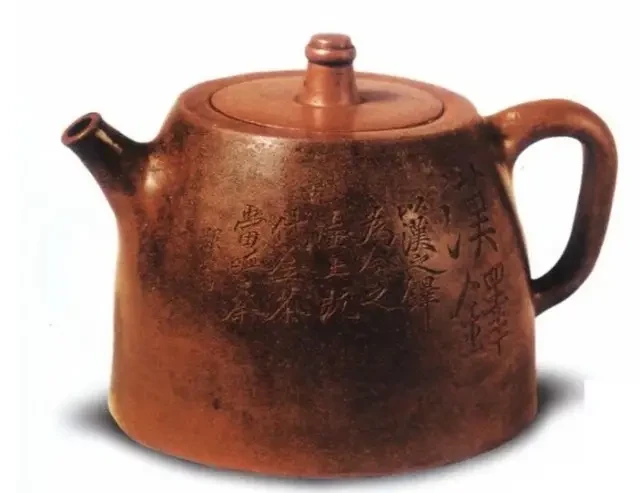
19. Shuiping — Balanced Round Form (水平)
Shuiping is a compact, rounded form with a domed lid, simple knob, straight rising spout and loop handle. The name is commonly translated as water level. For identification, look at the balanced relationship between these parts. The name alone is not a guarantee that an individual pot pours evenly or remains level when floated.

20. Xuehua — Snowflake Form (雪华)
Xuehua is an angular, typically hexagonal form. Its body, stepped lid and knob repeat the same faceted geometry. This example shows clearly defined planes rather than a rounded belly. The snowflake name provides a useful memory aid: look for coordinated facets across the whole vessel, not simply a square-looking handle in a side view.

21. Yilizhu — A Single Pearl (一粒珠)
Yilizhu means a single pearl. A full spherical body and small round knob give it a compact, bead-like appearance. The paired views in this photograph show how the same form reads from opposite sides. Unlike Duoqiu, the lid is visually quieter, allowing the large uninterrupted curve of the body to dominate.
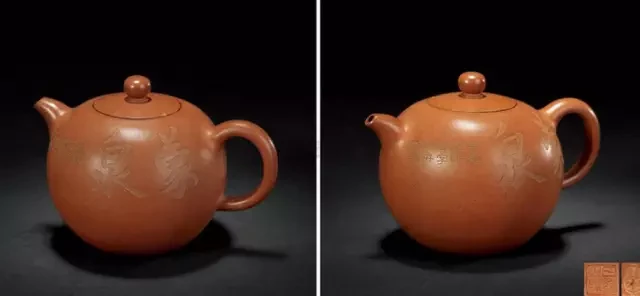
22. Danbao — Rounded Bail-Handle Form (蛋包)
The supplied Danbao example has a rounded belly, an open neck and a movable overhead handle. Its pronounced neck and substantial body separate it from the low, fixed-handle shapes nearby in the guide. The photo is especially useful for seeing the handle attachments. Treat the source name as a form label, rather than a claim about age or origin.
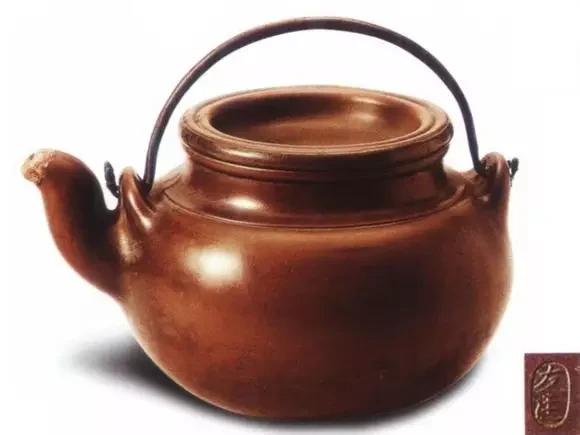
23. Hanwa — Tile-Inspired Form (汉瓦)
Hanwa brings together a cylindrical body, a wide opening and a low lid often topped by a bridge knob. The photographed pot has a sturdy side handle and a short spout. The broad lid is a useful identifying feature. Although the name references a Han tile, it is used for a teapot design rather than a production date.
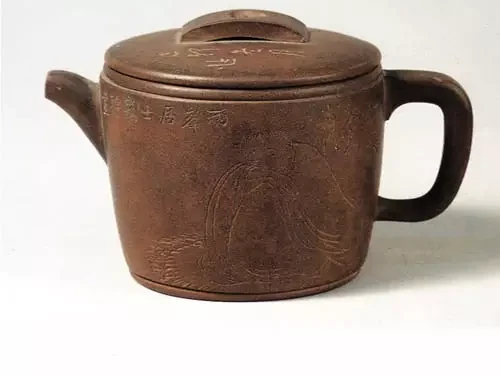
24. Jizhi — Tall Cylinder (汲直)
Jizhi is distinguished here by a tall, straight-sided cylindrical body. The narrow upper section and bridge knob extend the vertical rhythm, while the elongated handle follows the body’s height. Its scale of proportions contrasts strongly with low Jinglan or Zhoupan examples. The speckled clay surface is a feature of this photograph, not a requirement of the form.

25. Banwa — Half Tile (半瓦)
The source photograph shows a semicircular body: an arched top meets a flat base, rather like a tile standing on its edge. The two views reveal both the plain side and a decorated face. This is Banwa, or half tile; it should not be confused with Hanwa’s complete cylindrical body or a general tile-end design.

26. Paogua — Gourd Form (匏瓜)
Paogua takes inspiration from a gourd without reproducing a literal plant in every detail. The illustrated example has a broad, soft body and a rounded lid that continues its outline. Its short spout and simple handle keep the profile restrained. Compare it with Hulu, whose upper and lower sections make the gourd-like silhouette more pronounced.

27. Hulu — Bottle Gourd (葫芦)
Hulu means bottle gourd. Look for a rounded lower body and a narrower upper portion, suggesting the connected lobes of the plant. The photograph shows a domed lid, loop-like knob, short spout and rounded handle. Gourd forms vary considerably, so the transition between upper and lower volumes is more useful than one fixed outline.

28. Lianzi — Lotus Seed (莲子)
Lianzi refers to a lotus seed, but the shape is usually interpreted through smooth curves rather than literal botanical modeling. The photographed example has a rounded body, a domed lid and a curled extension at the bottom of the handle. Versions differ in height and shoulder shape; look for the overall soft, compact character.
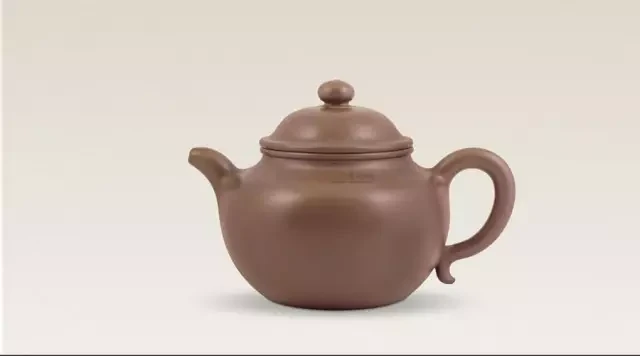
29. Hanbian — Flattened Round Form (汉扁)
Hanbian has a low, wide body, a broad shoulder and a lid set above a defined neck. In the example shown, the knob, lid and belly form a sequence of flattened curves. It is less extremely compressed than Xubian. Comparing those two silhouettes side by side is a useful way to learn the distinction.
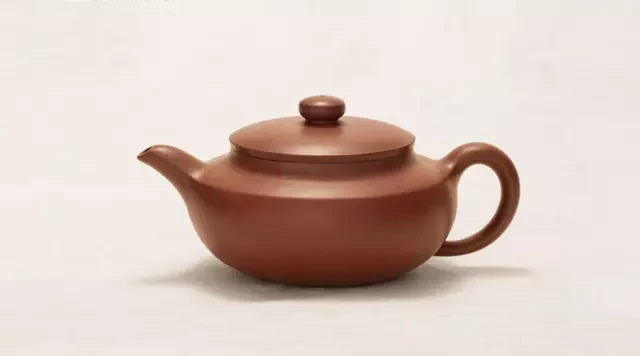
30. Qieduan — Eggplant Segment (茄段)
Qieduan uses the rounded fullness of an eggplant as its visual starting point. The curved, stem-like lid knob is the most memorable clue. The body itself stays simple, with a broad shoulder and a low, full belly. This is a stylized plant reference, in contrast with the literal bamboo texture of Zhuduan.

31. Banyue — Half Moon (半月)
Banyue combines a broad flat base with a smoothly arched upper body. In the supplied photograph, the lid sits close to the body and the shoulder curves downward without a tall neck. The outline suggests a half moon resting on its straight edge. Its rounded volume contrasts with Banwa’s more clearly semicircular, flattened face.
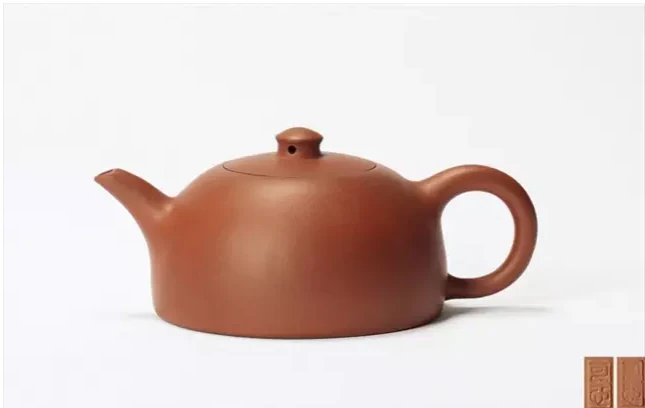
32. Baochun — Heralding Spring (报春)
Baochun uses spring blossom motifs to animate a rounded teapot. In this example, branch-like details appear on the spout, handle and lid, with modeled floral ornament around the body. Those naturalistic details distinguish it from a plain round form. The name expresses the arrival of spring; the exact flower and arrangement depend on the individual design.
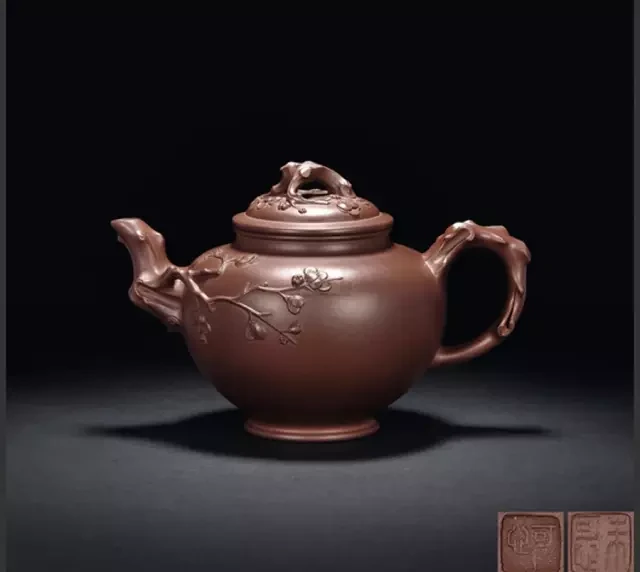
33. Zhuduan — Bamboo Segment (竹段)
Zhuduan treats the pot as a section of bamboo. The cylindrical body, joint-like bands and bamboo-shaped spout, handle and knob all contribute to that theme. The example shown also carries raised bamboo leaves across its front. Follow the repeated plant details across the fittings; a simple cylindrical pot with a bamboo inscription is a different design.

34. Hanjun — Angular Round Form (汉君)
The illustrated Hanjun has a low body, sloping shoulder and sharply defined lower edge. A bridge knob sits on its broad lid, while the spout and handle add curving lines. The body remains circular, but its profile is more angular than a softly rounded Fanggu. The shoulder and base transitions are the key features to compare.
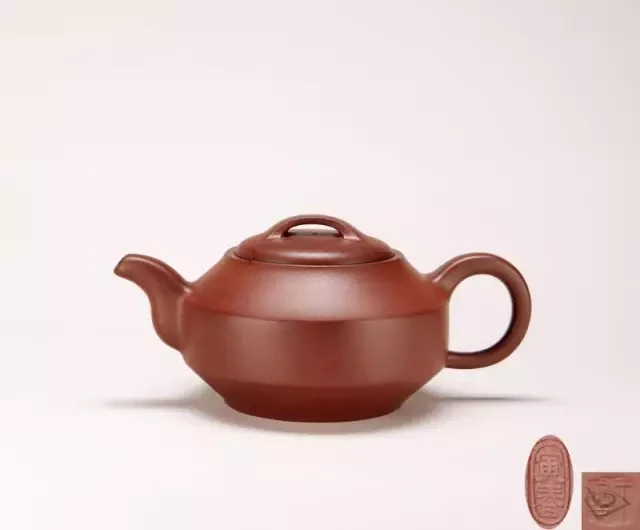
35. Yuhualong — Fish Becoming a Dragon (鱼化龙)
This sculptural design combines fish, dragons and waves. The body is divided into swelling wave-like sections, the handle has a scale pattern, and modeled creatures emerge from the surface. Some versions include moving details, but a still photograph cannot establish that mechanism. In this example, the fish-and-dragon relief provides the strongest identifying clue.
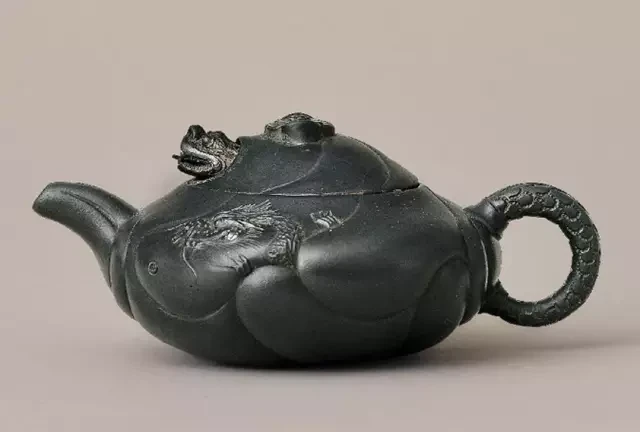
36. Zhegu Tiliang — Partridge Bail Handle (鹧鸪提梁)
A tall fixed overhead handle rises above a low cylindrical body. The handle’s asymmetric arch and slim supports give this form its distinctive outline. The source photograph supplies two views, useful for understanding its three-dimensional structure. The bird-related name refers to the design; it is not a literal sculpted partridge on the vessel.

37. Yaming Sifang — Four-Sided Form (亚明四方)
Yaming Sifang is a square-bodied design with flat faces and strong corners. The stepped lid, short angular spout and rectangular handle repeat that geometry. The photographed example shows how clean planes can provide space for inscription without softening the basic silhouette. Look for agreement between the body and fittings, rather than identifying a square pot by its body alone.

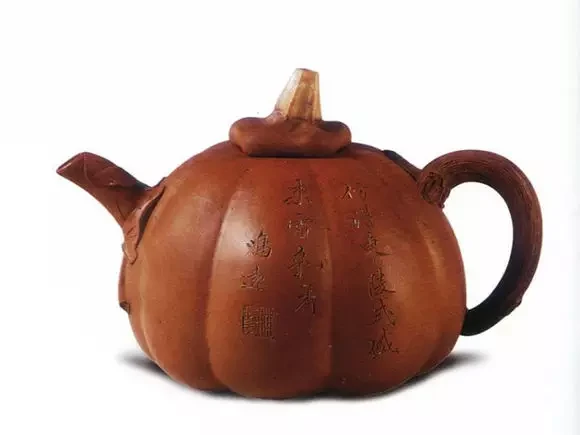
38. Nangua — Pumpkin (南瓜)
Nangua models a pumpkin directly. The body has deep, rounded lobes, while the stem-like knob, vine-like handle and leaf details carry the plant theme across the vessel. The lid follows the pumpkin’s upper contours. Unlike a plain pot with decorative ribbing, this example is clearly intended to read as a natural object.
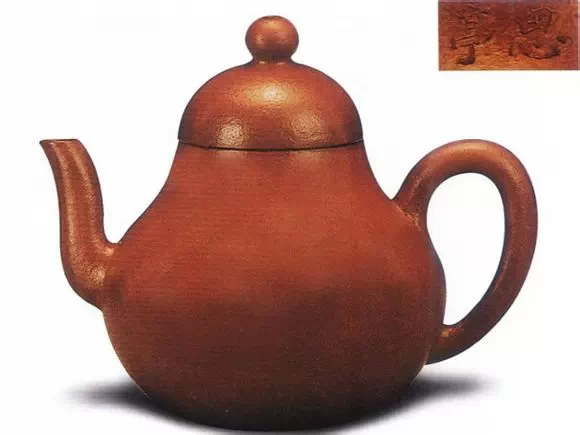
39. Siting — Pear-Like Form (思亭)
Siting has a full lower belly that narrows toward the upper body before meeting a high domed lid. A round knob continues the upward sweep, and the curved spout rises from low on the body. These connected curves produce its recognizable pear-like profile. Compare the narrow upper section with the more continuously oval Longdan.
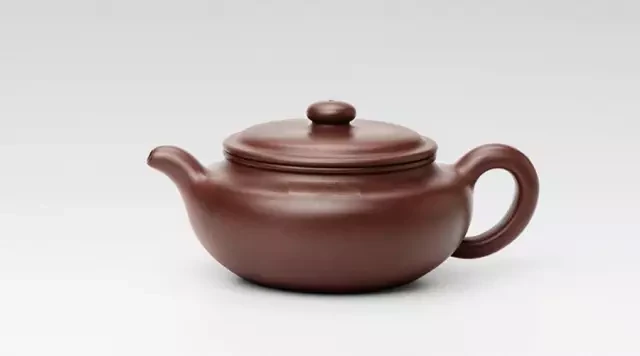
40. Bianfu — Flat Belly (扁腹)
Bianfu means flat belly. Its low, broad body and wide opening emphasize horizontal lines. The photographed example has a domed lid and softly curving fittings. Bianfu is a useful descriptive form name, and it can overlap visually with related low round shapes. Notice the body’s width relative to its height when comparing examples.
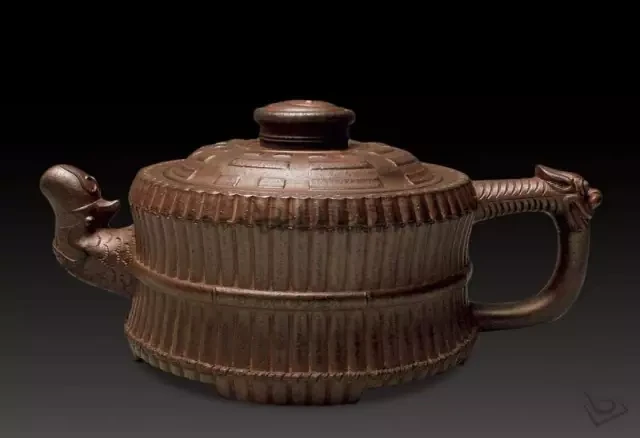
41. Bagua Longtou Yikun Zhu — Dragon and Bamboo Bundle (八卦龙头一捆竹)
The body resembles a tightly bound bundle of bamboo, with repeated vertical segments and a belt-like band around the middle. Dragon details extend into the fittings. The Bagua name also refers to the eight-trigram motif associated with the design. A side view does not reveal every lid detail or establish the exact number of modeled bamboo stems.
42. Gongchun — Tree Burl (供春)
Gongchun is recognized by its irregular, tree-burl-like body and textured surface. The National Museum of China holds a Gongchun-named teapot. The photograph here illustrates that naturalistic form; it does not by itself authenticate the maker or date of this particular pot.

43. Songshu Putao — Squirrel and Grapes (松鼠葡萄)
Squirrels, grape clusters and vine details are modeled around the teapots and fittings. The supplied image shows a coordinated tea set, which makes the repeated motif easy to see across pots and cups. The rounded vessel bodies act as a base for the sculptural decoration. The motif identifies a design family, not one fixed set size or arrangement.

44. Duozhi — Rounded Layers (掇只)
Duozhi brings together a rounded body, a raised upper section and a small domed lid. In this example, the belly is substantial and the neck is visibly narrower. It is related visually to Duoqiu, but the transitions and proportions differ. Compare the entire lid-to-body arrangement rather than trying to separate the forms using the knob alone.
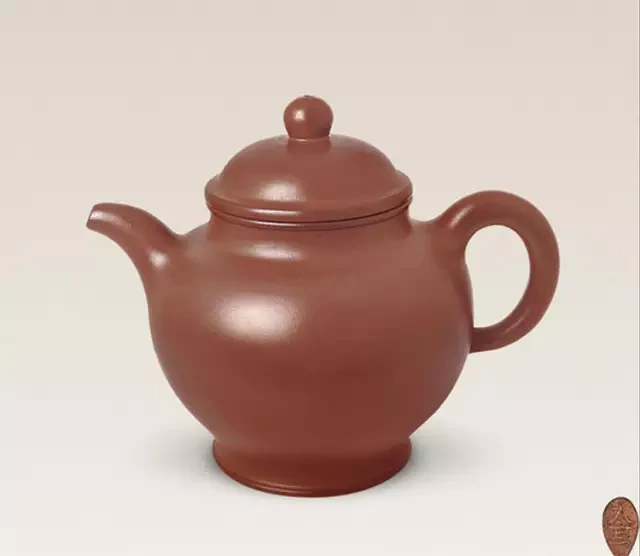
45. Heling — Joined Petal Form (合菱)
Heling uses repeating petal-like lobes across the body and lid. The rhythmic divisions meet at the lid seam, giving the whole pot a coordinated ribbed structure. In the photograph, a lobed knob continues the same theme. The repeated curves distinguish it from a plain sphere, even though the overall volume is still rounded.
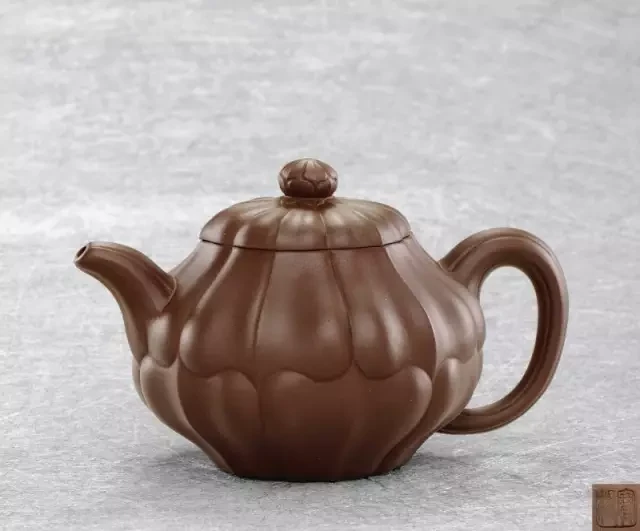
46. Gongdeng — Palace Lantern (宫灯)
Gongdeng means palace lantern. This example uses an upright rounded body, a distinct neck and a tiered upper section to suggest a lantern’s structure. A small knob caps the composition. The recognizable clue is the arrangement of body, neck and lid; specific proportions and decoration can vary between makers’ interpretations.

47. Dabin Ruyi — Auspicious Form (大彬如意)
The supplied Dabin Ruyi example has a swelling body, a patterned shoulder, a textured lid and three small feet. Ruyi means as wished, an auspicious expression also associated with decorative forms. Here, the shoulder ornament and supported body provide the visual clues. The traditional name should not be read as proof that this photographed pot was made by Shi Dabin.
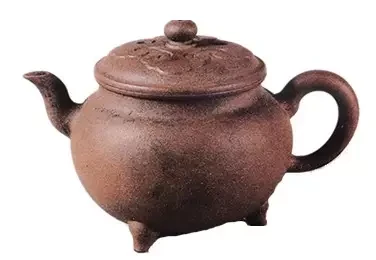
48. Shangxinqiao — Bridge Form (上新桥)
The bridge-shaped lid knob is the simplest feature to remember. Below it, a layered lid and low rounded body build a series of horizontal curves. The handle’s upper end also contributes to the architectural rhythm. This example illustrates how a familiar round teapot can become distinctive through the design of its fittings.

49. Tibi — Jade Disc and Bail Handle (提璧)
Tibi combines a low body with a broad lid and a tall fixed overhead handle. The name connects the lid with a bi, a traditional circular jade disc, and the handle with lifting. The supplied paired views show the open space enclosed by the arch. That strong relationship between handle and body is the main identifying feature.
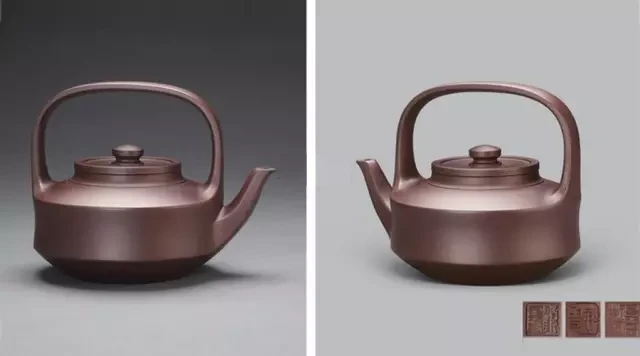
50. Julunzhu — Compact Round Form (巨轮珠)
Julunzhu, also encountered as Ju Lun Zhu, has a compact body, a substantial upper lid and a short straight spout. The photographed example has a high loop handle and engraved calligraphy. Its simple, closely grouped parts make it easy to compare with more elongated forms such as Siting or Jizhi.
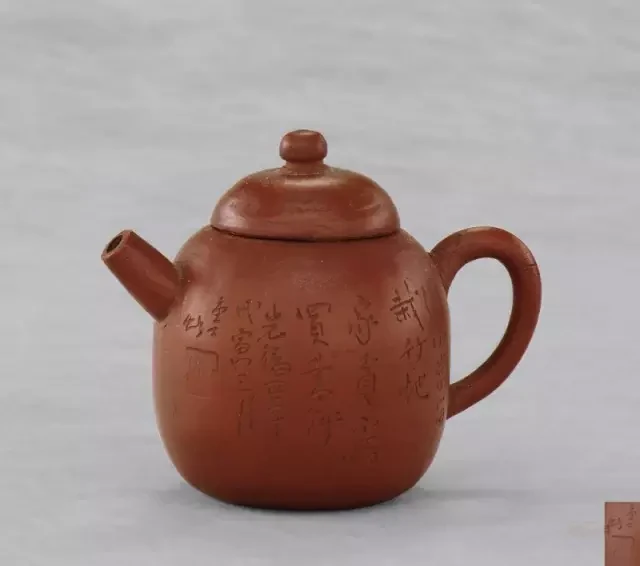
51. Huaying — Flower Bud (华颖)
Huaying uses overlapping rounded volumes to suggest a flower bud. In this example, the body is broad, the lid is smoothly domed and the round knob sits above a narrow neck. The curved spout and handle continue that soft rhythm. It offers another way to interpret the spherical family without adopting literal flower petals.
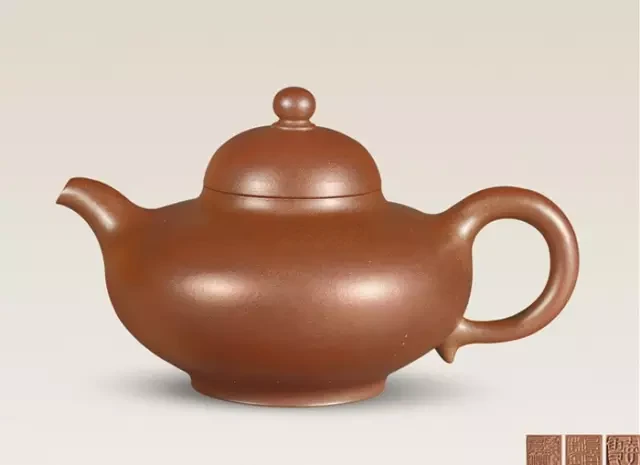
52. Paozun — Gourd Vessel (匏尊)
Paozun refers to a gourd vessel. The photographed teapot has a full, rounded body and a relatively broad, domed lid with distinct rings at its edge. Its short spout and substantial handle frame the belly. Compare that wide upper opening with the more constricted upper portion of the Paogua example earlier in the guide.
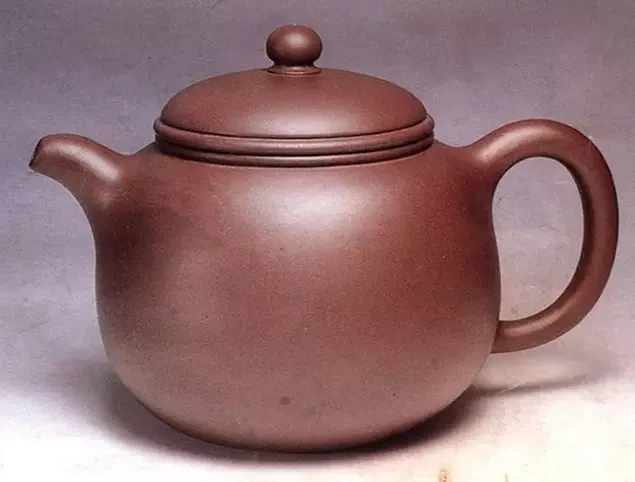
53. Yinbao — Wrapped Seal (印包)
Yinbao resembles a wrapped bundle. The square body is softened by modeled folds, and a tied cloth-like detail forms the lid knob. The sculpted spout and handle continue the decorative treatment. The defining feature is the wrapping motif, which distinguishes it from a plain square teapot even though both share a four-sided base.

54. Tangpo — Rounded Traditional Form (汤婆)
The source labels this example Tangpo. It has a full, low rounded body, a simple domed lid and a rising curved spout. Tangpo is also a name historically used for hot-water warming vessels, but the pictured object has teapot fittings. For this guide, identify the illustrated tea form by its profile rather than treating it as a bed warmer.

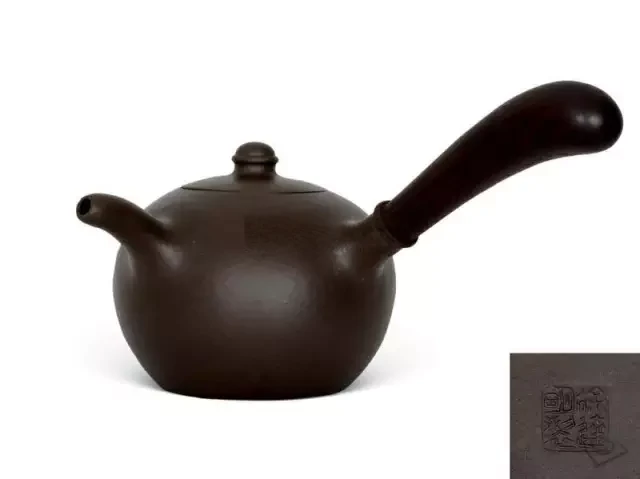
55. Tangyu — Side-Handle Form (唐羽)
Tangyu stands out through its long side handle. The handle projects from one side of the rounded body, while the short spout sits at a different angle. The compact lid keeps attention on that unusual arrangement. This example is best recognized as a side-handle teapot; the form name alone does not establish a Tang-dynasty date or provenance.
How to tell similar teapot shapes apart
- Xishi vs. Meirenjian: compare a nearly spherical body with a softer, sloping shoulder and a body that narrows toward the base.
- Duoqiu vs. Duozhi: follow the sequence of knob, lid, neck and belly. The whole arrangement matters more than one rounded component.
- Fanggu vs. Hanbian vs. Xubian: compare body height, shoulder transitions and lid profile. Xubian is especially compressed.
- Jinglan vs. Hanwa vs. Jizhi: these cylindrical forms differ in height, opening and lid treatment. Jizhi is markedly upright; Hanwa commonly has a broad lid and bridge knob.
- Banyue vs. Banwa: Banyue has a softly arched three-dimensional body over a flat base. The Banwa photograph shows a more explicit semicircular face.
What teapot shape tells you about everyday use
The silhouette helps you identify a design, but practical details still deserve a closer look. Compare the actual opening for adding and removing leaves, the handle clearance, the lid grip and the pot’s balance when filled. Ask for a pouring video if flow matters to your choice. Body shape alone cannot predict flavor or prove a pot suitable for one particular tea.
Keep capacity separate from appearance: a low pot may hold more than a taller one. Our usable teapot capacity guide explains how to compare sizes. For clay terminology, see the Yixing clay guide; for maker and production claims, use the authenticity checklist.
Common questions about Yixing teapot shapes
Do all Yixing teapot shapes have an official English name?
No. English sellers may use literal translations, descriptive names or different pinyin spacing. Keep the romanized name together with the Chinese characters and a visual description. “Banyue,” “Ban Yue” and “Half Moon” may refer to the same form family.
Is one teapot shape always best for a particular tea?
A shape label alone is not enough. Opening, usable capacity, flow and handling vary within the same named form. Compare the actual vessel and your brewing routine before deciding.
Does a traditional shape mean a pot is antique?
No. Traditional designs continue to be made. A Qin-, Han- or Tang-related name may describe an inspiration rather than a manufacturing date. Dating requires separate evidence; see our vintage Yixing teapot guide.
What are Mansheng teapot forms?
Mansheng was the art name of Chen Hongshou. The National Museum of China describes his collaboration with potter Yang Pengnian and eighteen teapot designs. That historical tradition helps explain why literary names appear in Yixing form vocabulary; it does not authenticate a modern pot carrying a related name.
When learning a teapot shape, remember three things: its overall silhouette, the transition between lid and body, and the arrangement of spout and handle. Those features make the name useful when the next example looks a little different.