Sandao · Chinese teaware & culture
Huaxiangyuan Tea: Company, Tea Estates & Products
← Chinese Tea Brands & Companies
Huaxiangyuan Tea (华祥苑) is a Chinese tea company founded in 2001. Based in Xiamen, Fujian, the company combines tea cultivation, research, processing and sales with a network of branded stores. Its defining theme is the tea-estate model: linking tea-growing regions, production and quality management with products sold under a single brand.
Company and brand at a glance
| Chinese company name | 华祥苑茶业股份有限公司 |
|---|---|
| Brand | Huaxiangyuan / 华祥苑 |
| Founded | 2001, according to the official company introduction |
| Founder | Xiao Wenhua / 肖文华 |
| Corporate location | Xiamen, Fujian, China |
| Business focus | Tea cultivation, research, processing, branded tea sales and franchise development |
| Official website | hxytea.com |
The company’s modern history begins in 2001, when its first store opened in Xiamen. The founder’s family background in Anxi tea making is an earlier heritage story. Xiamen is the corporate location; Anxi, Wuyi Mountain, Fuding and other regions help explain the tea portfolio.
Main business
Huaxiangyuan operates across several stages of the tea business. The official company profile describes tea-growing resources, product research, production and processing, quality testing, and sales through branded retail channels. It identifies production bases in Xiamen’s Tong’an district, Anxi, Fuding and Menghai.
Retail and franchise development connect that supply chain with consumers. The official website maintains a store finder and publishes store-opening news, alongside a separate franchise service. Tea gifts, small-tin presentations and tea-inspired foods extend the offering beyond loose-leaf tea alone.
Representative product lines and their characteristics
The catalog has two layers: named product lines and tea categories. A name such as Guobin describes a collection within the brand; Tieguanyin or pu-erh tells you more about the tea inside. One named collection can therefore contain several tea types.
| Product line | Examples in the official catalog | What distinguishes it |
|---|---|---|
| Guobin Tea / 国缤茶 | Rougui, old-bush Shuixian, Tieguanyin, Jin Jun Mei, and pu-erh selections. | Small blue and red tins, tasting packs and gift formats organize a multi-category collection. The star designations are the brand’s own product labels. |
| Guibin Tea / 贵宾茶 | Light-aroma and roasted-style Tieguanyin, Rougui and Phoenix Dancong. | A collection with business-pack and larger presentation options, letting a customer choose both tea style and pack format. |
| Yingbin Tea / 迎宾茶 | Pu-erh, roasted-style Tieguanyin and Rougui. | A separate named range spanning several tea categories and pack sizes. |
| Silk Road Fragrance / 丝路传香 | Dahongpao, white tea, pu-erh, Rougui and light-aroma Tieguanyin. | A Silk Road-themed collection with classic multi-tin packs and gift presentations. |

Rougui and Shuixian are tea-cultivar names that recur across the collections. For a practical comparison, start with the tea type and cultivar, then aroma style, roast and pack format. The same collection name can bring together teas with very different flavor profiles.
Main tea categories and product features
| Category | Products and features shown by the brand |
|---|---|
| Tieguanyin oolong | The Anxi-linked core of the brand’s craft story. The catalog presents light-aroma and roasted-style teas, including Diaoyutai and Golden Phoenix collections. These aroma styles are useful distinctions when comparing products. |
| Wuyi rock oolong | The Wuyi Impression collection includes Shuixian, Rougui and Dahongpao. The brand emphasizes floral aroma and the traditional rock-tea character, with cultivar and roast offering further points of comparison. |
| Pu-erh tea | The catalog separates raw and ripe examples, including a five-star Banzhang raw pu-erh and Bulang Zhengshan ripe pu-erh, both listed as 357 g cakes. Raw and ripe are different processing styles, not interchangeable grade names. |
| White tea | The Ruyi white tea collection sits alongside white teas in other named ranges. Production year, leaf material, form and storage information help distinguish individual products. |
| Green tea | Longjing, Enshi Yulu, Anji Baicha, Xinyang Maojian and Rizhao green tea appear as separate series. Despite its Chinese name, Anji Baicha belongs to green tea rather than the white-tea category. |
| Black tea | A dedicated black-tea section emphasizes Tongmuguan in its presentation; Jin Jun Mei also appears in the Guobin catalog. The precise origin and specification should be read at product level. |
| Tea-inspired foods | Examples include green-tea-flavored seeds, Tieguanyin-flavored seed brittle, black-tea-flavored preserved fruit, pu-erh pineapple pastries and Dahongpao date-and-walnut cake. Here tea is used as a flavor ingredient in snacks. |
The eight tea estates on the official website
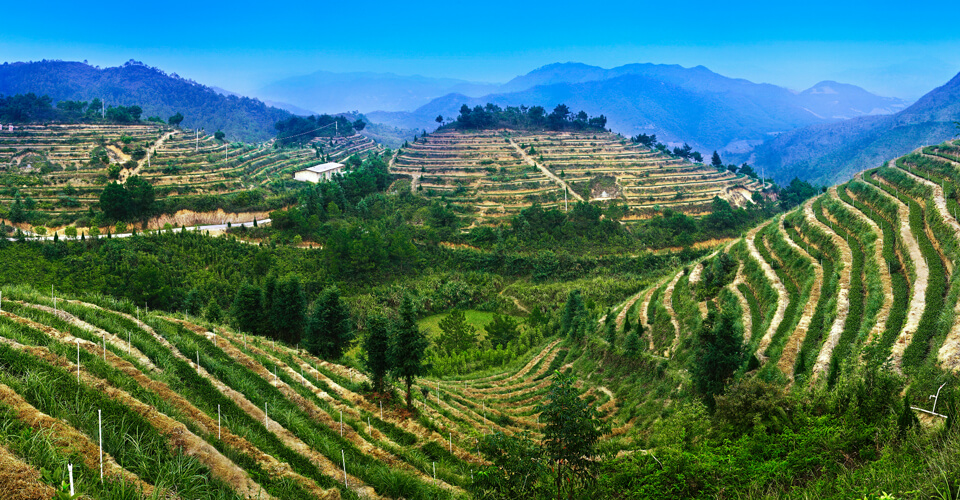
The estate page maps eight locations across four provinces. This regional layout is central to the company’s presentation: different tea types are connected with different growing environments.
| Location | Tea direction presented |
|---|---|
| Anxi, Fujian | Tieguanyin |
| Fuding, Fujian | White tea |
| Gutian, Ningde, Fujian | Black tea |
| Wuyi Mountain, Fujian | Rock oolong |
| Menghai, Yunnan | Pu-erh |
| Xinyang, Henan | Green tea |
| Yunnan | Dianhong black tea |
| Zhejiang | Green tea |
The estate map describes the company’s published layout. It is a different level of information from the origin wording on a particular pack, especially in a catalog that also lists teas from other places.

Tea craft, research and quality management
Huaxiangyuan links its Anxi heritage with traditional oolong craftsmanship. The craft page introduces founder Xiao Wenhua, tea maker Liu Yuanming, cooperation with Fujian Agriculture and Forestry University, and work with the Fujian Academy of Agricultural Sciences.
Its quality-system page organizes eight standards around sourcing, ecology, cultivation, craft, testing, production, taste and packaging. Four control stages cover prevention, supervision during production, subsequent testing and traceability. The company also describes controlled storage and a research-and-testing center. These are its published management approaches, rather than a separate certification attached automatically to every product.

Stores and official company contacts
| Address | 23F, Huaxiangyuan Building, 62 Taidong Road, Guanyinshan, Siming District, Xiamen, Fujian, China |
|---|---|
| Customer service in China | 400-885-8788 |
| Franchise enquiries in China | 400-850-6666 |
| Store finder and contact information | Official contact and store page |
Customer service and franchise enquiries have separate numbers. For a specific tea or order, contact the official shop or store handling the purchase.
Official sources and information date
Reviewed 26 October 2026. This independent Sandao profile uses Huaxiangyuan’s company introduction, estate map, craft and quality pages, product catalogs and contact page linked above. Photos: Huaxiangyuan official website. Current stock and packaging can change; historical event sponsorships and marketing sales rankings are not treated as blanket product endorsements or present-day market comparisons.