Sandao · Chinese teaware & culture
Keqintang and the Rao Family’s Yuan-Style Porcelain
Chinese Tea Brands & Companies · Jingdezhen Ceramics
Rao Keqin · Rao family · Jingdezhen, Jiangxi, China
From research into Yuan blue-and-white
A family interview published by Tuicang traces Rao Keqin’s involvement in research to recreate Yuan-style blue-and-white to a 1979 project at the Jingdezhen ceramics museum. The inquiry involved form, clay, glaze, cobalt and firing. Those details help explain how the workshop brings the appearance of Yuan porcelain to newly made pieces.
How the Rao family works
The interview describes Keqintang as a family workshop on Sanbao Road. Members prepare clay, Rao Zhiyang works on molding and forming, and Rao Keqin paints alongside Rao Mingyuan and Lijun. Work moves directly among the relatives who form and decorate the pieces.
From the large jar to the small cup
Keqintang’s Yuan-inspired work often uses stacked decorative bands. A jar’s belly, shoulder and rim can each carry a different motif, setting a rhythm around the main composition. When a figure story, dragon or fish design moves to a small cup, the spacing and density of the lines change with the scale.
Cobalt in Rao family porcelain
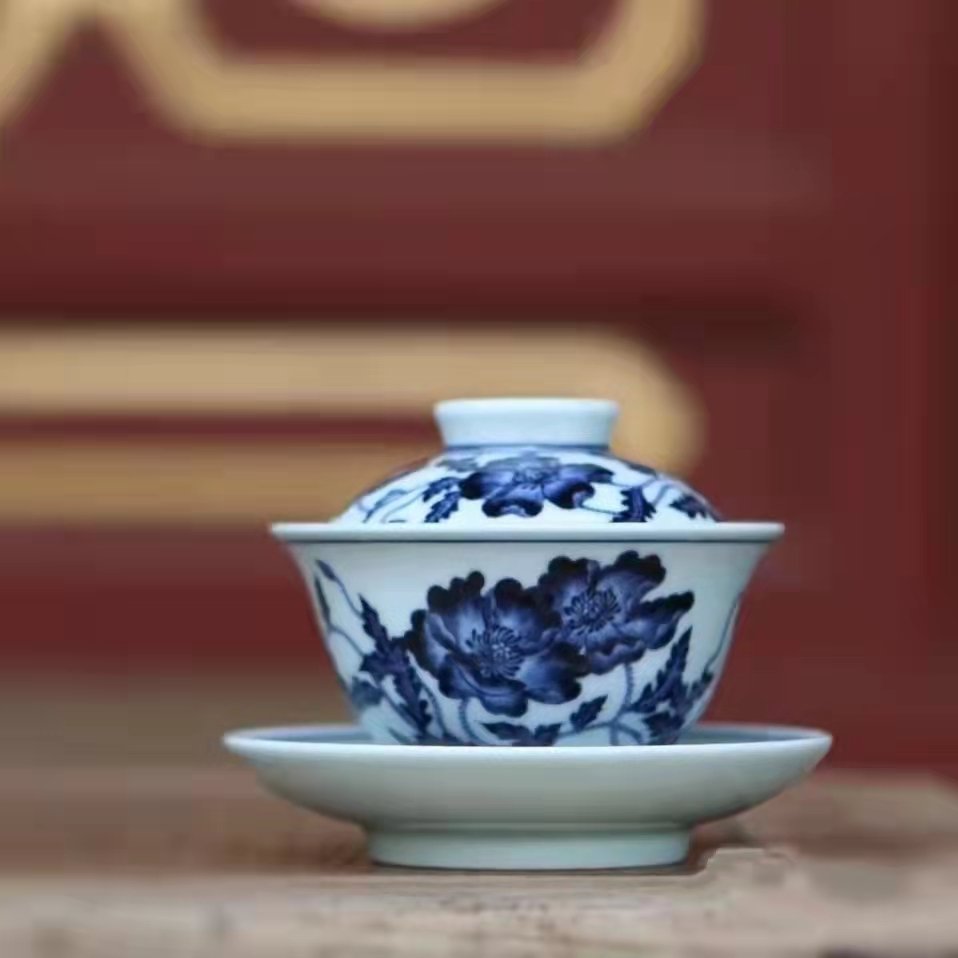
In a Dongjia feature, Rao Mingyuan describes blending multiple cobalt materials. Compare the deeper color where strokes meet with the pale spaces between them. The workshop’s cups, dishes and large vessels offer different surfaces for the same visual language.

Lotus, egrets and waves
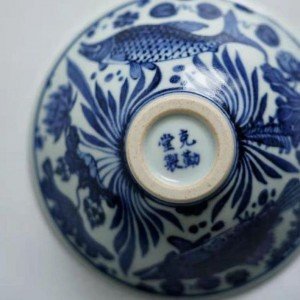
The catalogue’s lotus-and-egret pot stand spreads dark and pale cobalt across a relatively flat surface. A large waves bowl carries its design around a curved wall. A base view of the conical fish cup shows the foot and adjacent painting. Together the pieces show how surface shape governs the drawing.

Sources and object records
This profile draws on family interviews and public object catalogues. For a particular piece, record its measurements, full side view, base and provenance together. In a catalogue, Yuan-style describes the historical reference for the design and can be recorded separately from the piece’s own date.