Tea & Teaware Guides
Tea Company Management: 12 Areas and 17 Common Problems
Edited and translated from the original essay. Experience-based judgments are presented as industry perspectives; historical context and data are not represented as current market conditions.
Tea companies manage more than tea production
A tea business may cultivate a crop, process leaves, develop packaged products, run wholesale accounts and serve customers in stores or tea spaces. Those activities connect agriculture, manufacturing and commerce. Cultural and visitor experiences can add further responsibilities.
The source essay focuses mainly on medium-sized and larger Chinese tea enterprises. As a company expands, concentrating every decision in the owner’s hands becomes harder. Better management means connecting activities and responsibilities, not simply adding more staff or buying more equipment.
Company-size labels also need context. The 2017 statistical classification cited in the original uses different indicators and thresholds for different industries. A tea grower, manufacturer and retailer should not all be assigned a size from one universal sales number. The original classification is linked below; it is a statistical reference, not a substitute for identifying a company’s actual activity.
Twelve connected areas of work
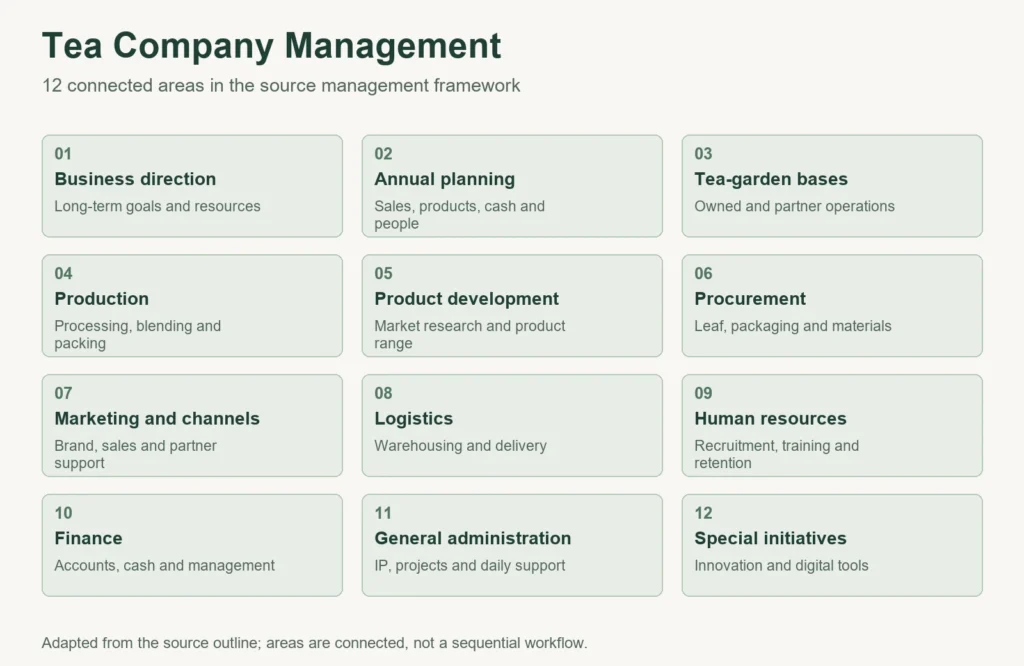
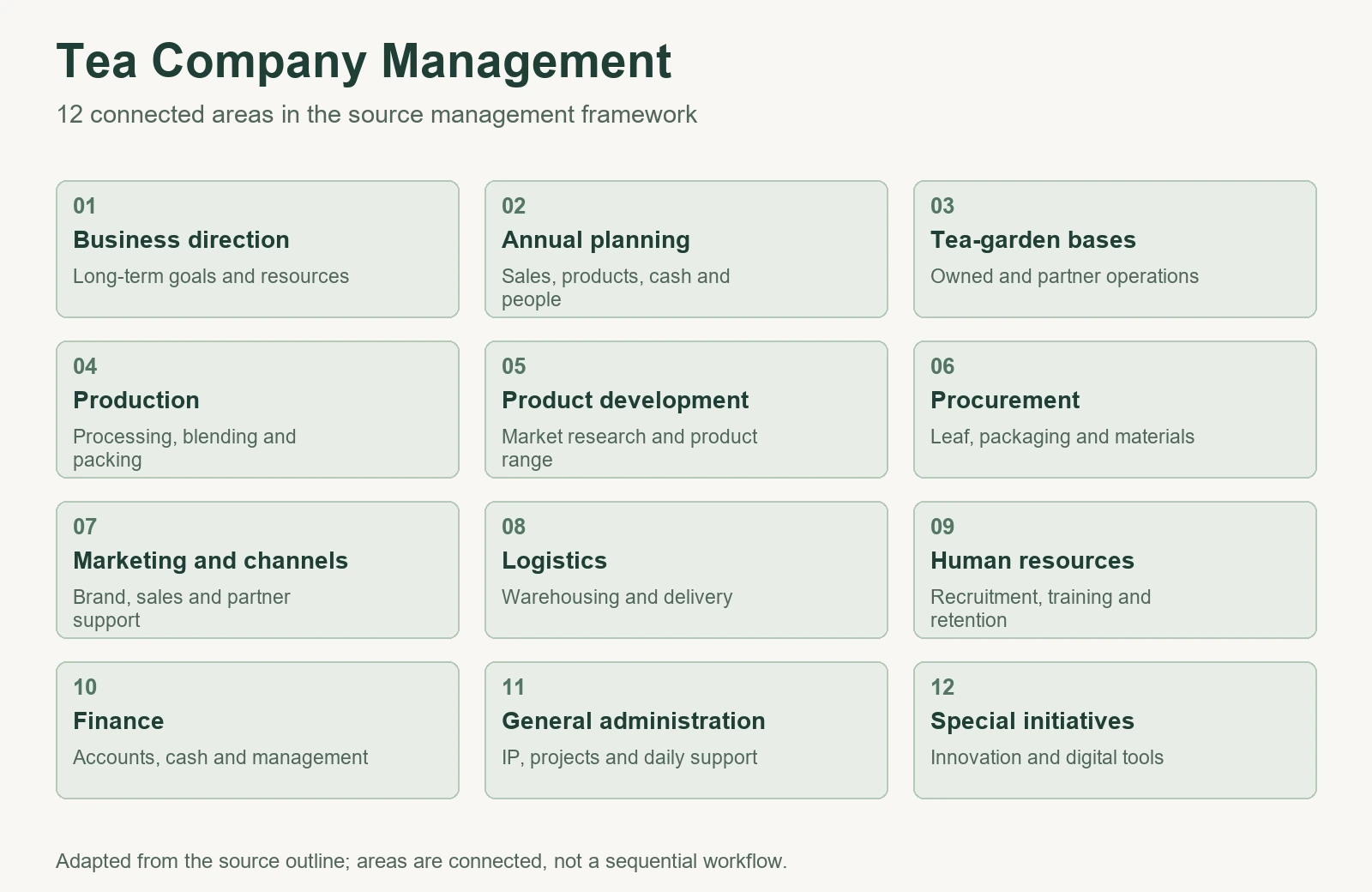
The outline below follows the source’s twelve areas. A small company may combine several roles; a larger company may need specialist teams. The important question is whether each responsibility has a clear owner and works with the rest of the business.
| Area | Responsibilities in the source outline |
|---|---|
| 1. Business direction | Five-, three- and one-year goals; the resources and route needed to reach them |
| 2. Annual planning | Sales and brand plans; products, R&D, production, procurement, cash and staffing |
| 3. Tea-garden bases | Owned gardens, partner gardens and tea-tourism activities |
| 4. Production | Picking and receiving fresh leaf; primary and refined processing; blending, packing and technical improvement |
| 5. Product development | A planned range, market research, concepts, prototypes, packaging and market introduction |
| 6. Procurement | Fresh leaf, partly processed tea, packaging and supporting materials |
| 7. Marketing and channels | Brand planning, communication, channels, key customers, e-commerce, sales-team development and partner service |
| 8. Logistics | Warehouse operations and transportation |
| 9. Human resources | Workforce planning, recruitment, onboarding, training, pay, performance and employment relationships |
| 10. Finance | Accounting, cash and financial management |
| 11. General administration | Daily support, reception, business administration, intellectual property, projects and events |
| 12. Special initiatives | Innovation and digital development |
Planning, resources and production: the first seven problems
The first group of problems concerns direction and the resources used to pursue it. A long-range plan should guide annual work, while the annual target must remain connected to the company’s actual capabilities. Attention to the future and attention to today are complementary, not competing excuses.
The source also challenges a familiar imbalance: visible investment in buildings and machinery can move faster than investment in people and systems. Traditional craft does not remove the need for clean, dependable production management. Likewise, a large garden portfolio is only useful if the company can manage the leaf supply effectively.
| Problem | What to examine |
|---|---|
| 1. No overall plan | A credible longer-term goal, route and resource plan |
| 2. Targets exceed resources | Whether the team, budget and supply can support the annual ambition |
| 3. Immediate gains dominate | What today’s decisions leave for the company’s future |
| 4. Hardware outruns systems | Investment in people, processes and organizational capability |
| 5. Production outruns marketing | Whether market demand informs what is made |
| 6. Modern production management is neglected | Craft, equipment, hygiene and process control working together |
| 7. Garden control exists only on paper | Effective standards and coordination for owned and partner gardens |
Products, brands and channels: problems eight to fifteen
A product range needs more than individually attractive items. Price bands, pack formats and intended uses should make sense together. Product development begins with a buyer and a use, not only a new name on a new box.
Brand management is broader than publicity. A trademark gives a name a form of protection; a brand also depends on a coherent promise, recognizable character and the experience delivered over time. Exhibitions, advertising and social media should contribute to that work rather than substitute for it.
Channels need planning and service after recruitment. When offers conflict, examine product specifications, stock flows, promotions and agreements before declaring every price difference a problem. The aim is a workable relationship with partners and clear information for customers, not a simplistic demand that every seller always display one identical price.
| Problem | What to examine |
|---|---|
| 8. No market-facing development system | Who researches needs, tests concepts and learns from sales |
| 9. A new product is only a new name or pack | What has actually improved for the buyer |
| 10. No plan for the product portfolio | Gaps, overlaps, levels and consistency across the range |
| 11. Publicity without brand management | The promise, positioning, character and structure behind the name |
| 12. A narrow promotion toolkit | A coordinated communication plan suited to the audience |
| 13. No channel plan | Which channels fit the company and each product |
| 14. Weak partner support | Training, information, service and follow-through after recruitment |
| 15. Conflicting prices and channels | Comparable specifications, offer terms and transparent partner coordination |
People and retention: problems sixteen and seventeen
Personnel administration is not yet a complete human-resources system. Recruitment, training, responsibilities, pay and performance need to reinforce one another. A tea marketer may need both product understanding and commercial skills; knowing only one side can leave a gap.
The source describes a limited pool of experienced staff, strong geographic ties and difficulties retaining people. These are observations from the author’s industry experience, not a measured explanation for every company. Each business still needs to examine its own working conditions, career paths, management and compensation.
| Problem | What to examine |
|---|---|
| 16. Personnel work without an HR system | How recruitment, development, reward and performance connect |
| 17. Hard to recruit, harder to retain | The value offered to capable people and the reasons they leave |
Four priorities for improvement
First, face problems directly. A problem defined against a clear goal can become a practical improvement opportunity. Lowering expectations until every weakness disappears from view is not the same as solving it.
Second, put important work first. Use the company’s goals and available resources to decide what needs action now, what can follow and what should stop. This applies to annual plans as much as to a person’s daily workload.
Third, build the organization and develop people. Shared processes should handle recurring work, with unusual cases receiving appropriate attention. Reducing dependence on one owner or manager gives a growing company more room to function.
Fourth, respond to difficult conditions with realistic action. The original was written during the pandemic period in 2022; its references to that year’s pressures are historical. The enduring management question is how to use the resources you have to improve products, service and organizational capability, rather than treating confidence alone as a plan.
References
Related reading
- Why Chinese Tea Companies Struggle to Scale: Five Barriers
- Tea Business in Difficult Times: Create Your Own Good News
Explore Tea Industry Research in Tea & Teaware Guides
Source attribution
Reprinted from Deng Zengyong’s self-media publication, Tea Industry Management Review. Edited and translated into English by Sandao.