Tea & Teaware Guides
Chenpi Pieces vs Whole Three-Lobed Peel: Does Shape Matter?
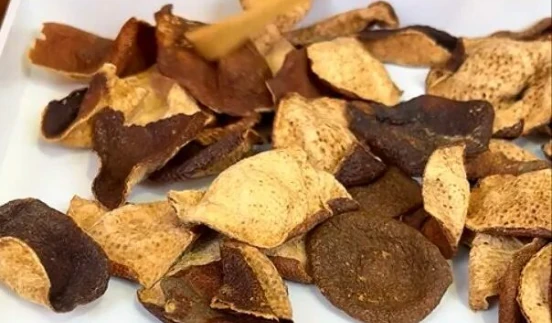
Three lobes describe a shape, not a grade
A whole piece of Xinhui chenpi often opens into three connected lobes. Separate pieces may look less impressive, particularly in a gift box, but their shape alone does not tell you whether the peel tastes good or comes from the claimed place.
The useful distinction is between an intact presentation and the condition of the material. Broken peel can come from handling otherwise sound stock. It can also be mixed from poorly documented batches. The questions to ask are where it came from, how it was dried and stored, and what the seller can substantiate.
How the two-cut method opens the peel
In the source’s two-cut illustration, one cut travels along the fruit and another divides the remaining section. The result opens into three connected lobes, with the stalk area associated with one lobe. The paths are a guide to the peeling pattern, not a laboratory test for age.
The source credits these peeling-method illustrations to Gan Zhi Lin (柑之林). The restored images below preserve the explanatory layout; fine visual details should not be used to authenticate a purchased batch.

The three-cut pattern can also produce a whole peel
The other illustration uses three cuts radiating from a common area so the peel can open into connected sections. Both cutting approaches can produce an intact three-lobed shape. A neat outline does not establish whether the peel was opened by hand or with assistance, nor does one cut pattern prove that it is old.
For a buyer, learning the cutting methods is helpful for understanding the product’s appearance. It is not a substitute for a harvest year and storage record.

Why pieces break away
Dry peel can become brittle, and turning, packing, transport or daily handling can separate the lobes. Repeated handling creates more opportunities for breakage. Still, a fragment is not proof of long aging: a young, dry peel can break too.
Likewise, an intact piece is not evidence that it was artificially aged. Some batches simply receive gentler handling. Avoid using either the amount of loose pith or the number of fragments as a shortcut to an exact year.
Choose for drinking, cooking or presentation
For gifting, an intact peel can be worth a presentation premium. For brewing or cooking, separate pieces can be convenient if the origin, condition and batch are equally clear. Compare prices by weight and documented specification, not by how full the bag looks.
If two products really are from the same sound batch, breakage alone is not a sound reason to promise different medicinal effects. Compare flavor using equal weights rather than “one piece,” since fragment size varies. Pay for the information and condition you can verify, then decide what appearance is worth to you.
Continue exploring chenpi
Source attribution
Reprinted from Dong Cha Di (懂茶帝), an independent tea media publication. Edited and translated into English by Sandao; promotional material has been removed and research and food-safety claims have been reviewed for scope.