Tea & Teaware Guides
Handmade Teapot: Fully Handmade vs. Half-Handmade
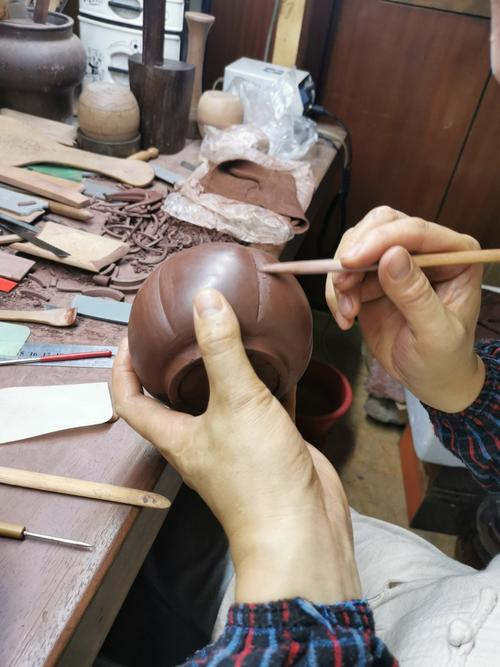
A handmade teapot can involve mold assistance. That may sound contradictory, but in Yixing, China, forming the clay body is only part of the work. Joining, refining, fitting and finishing still depend on the maker’s hands.
The useful distinction is between fully handmade and half-handmade, often called semi-handmade. The difference concerns how the form is shaped. It does not, on its own, establish the clay’s origin, the quality of the finished pot or how much you will enjoy brewing with it.
Fully handmade vs. half-handmade: the difference
In the Yixing trade, fully handmade generally describes a pot whose body and components are shaped without forming molds. The maker still uses tools: paddles, scrapers, gauges and cutting templates are part of the craft. “Fully handmade” does not mean working with bare hands alone.
A half-handmade pot uses a mold to help shape or standardize the body, one or more components, or both. The clay is then assembled and finished by hand. The term does not mean that exactly half the labor is manual. Because sellers use these labels differently, ask which parts involved a mold.
| What to compare | Fully handmade | Half-handmade |
|---|---|---|
| Forming the shape | Shaped without forming molds. | Molds assist the body, components or both. |
| Handwork | Forming, assembly, fitting and finishing. | Clay preparation, assembly, refinement and finishing remain important. |
| Useful evidence | A clear account of the complete forming process. | A clear account of where molds were used. |
| What the label does not establish | Better clay, better tea or investment value. | Lower quality, poor clay or an inferior pour. |
What “handmade” means for a Chinese Yixing teapot
Yixing lies in Jiangsu Province in eastern China. Its zisha tradition includes shaping prepared clay slabs into rounded bodies, joining panels for angular forms, and combining construction with sculptural work. China’s official heritage record describes this range of hand skills, followed by surface finishing and decoration.
This is why the broad phrase “handmade Chinese tea pot” needs context. It can refer to different materials and workshop methods. Here, we are discussing Yixing zisha rather than treating every handmade ceramic teapot as the same kind of object.
There is another distinction worth making: mold-assisted shaping of workable clay is not the same operation as slip casting, which uses liquid clay slip in an absorbent mold. A listing should name the actual process instead of relying on “handmade” as a catch-all description.
Judge the finish without demanding mechanical perfection
For close-up examples of seams, tracks and other surface traces, see our guide to handmade teapot marks and defects.
The original article raises a fair concern: buyers can become so focused on tiny marks and perfect symmetry that they lose sight of the finished pot. A well-made teapot should feel coherent. The spout, handle, lid and body should belong together, rather than looking like separate parts competing for attention.
Practical fit matters, too. Ask for a pouring video, look for unwanted leakage around the lid, and consider whether the handle leaves enough room for your fingers. Those checks tell you something about use. A lid test or an unusually neat surface cannot certify a forming method.
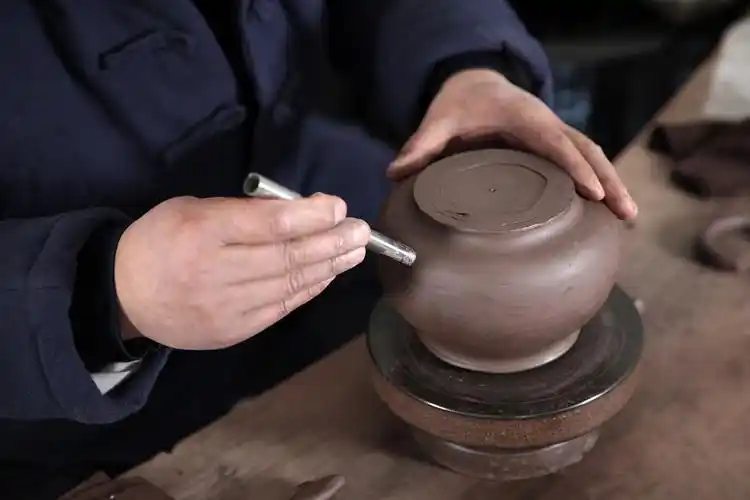
Small variations can be part of handwork, but they are not an excuse for cracks, unstable construction or a poor pour. Equally, precise workmanship is not evidence that a pot must be machine-made. Look at what the variation means for the object in front of you.
Why mold assistance does not remove the maker’s role
A mold can help establish a repeatable contour. It cannot explain the whole finished piece. The transitions where the spout and handle meet the body, the treatment of the rim and foot, and the fitting of the lid still deserve attention.
Consider a familiar shape made by two different workshops. Even when a mold assists both, the finished pots may differ in proportion, surface treatment and comfort in the hand. The useful question is what the maker did with the method, alongside an honest description of that method.
Decoration is another separate stage. A carefully worked lid or carved surface can show skilled handwork without telling you how the body underneath was formed.
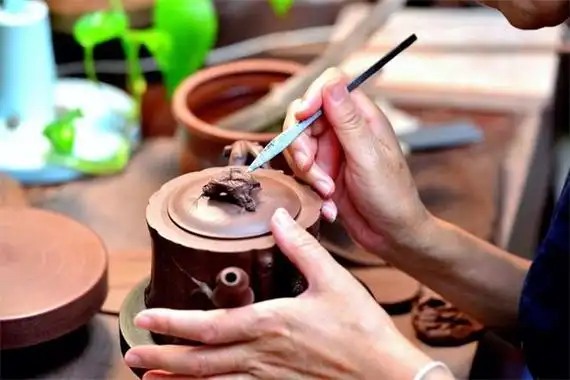
For someone who values forming skill and the freedom to develop an individual shape, a fully handmade piece may be especially appealing. For everyday brewing, a well-finished half-handmade pot can also deserve a place on the tea table. Neither choice needs to be defended by dismissing the other.
Can seams or tool marks prove a teapot is fully handmade?
A seam needs interpretation. Clay parts can be joined during hand construction, while mold-assisted pieces can be carefully refined until obvious traces are difficult to see. A line in one photograph is a clue to investigate, not a verdict.
The same applies to tool marks, a maker’s stamp or a certificate. None establishes the complete manufacturing history by itself. Photographs of someone finishing a pot show that particular stage; they do not show every earlier stage.
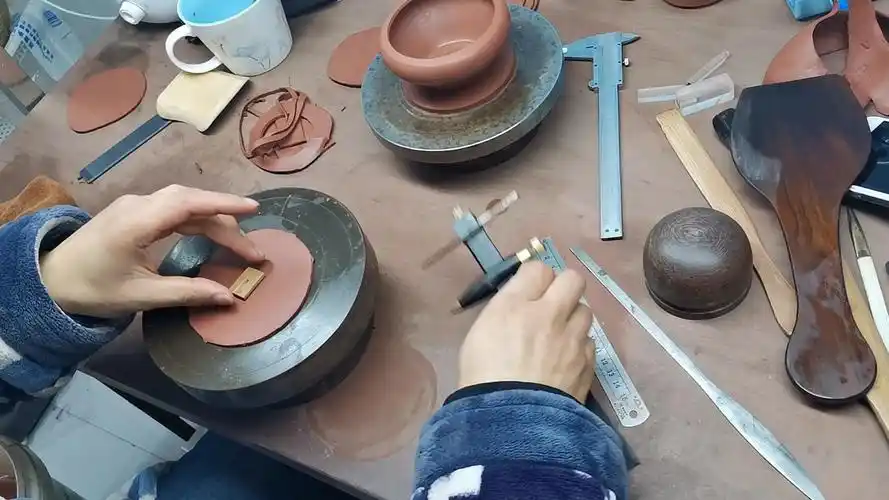
Ask for process photographs or footage connected to the specific piece, plus a description of which parts were formed and how. For a fuller purchase checklist, see our guide to assessing handmade Yixing teapot claims.
Clay texture is a separate question
The source article also discusses visible particles and small color variations. These should be considered in context rather than treated as automatic flaws—or automatic proof of authenticity. A photograph of a speckled surface cannot establish where the clay came from.
Ask how the clay is described, what information the seller has about its source, and whether there are any cracks or damaged areas. Our Yixing clay types guide explains common names such as Zi Ni, Zhu Ni and Duan Ni without using color alone as an identification test.
Choosing a handmade teapot you will actually use
Before paying extra for a label, work through a few practical questions:
- What is the forming method? Ask whether the body, lid, spout or handle involved mold assistance.
- What supports the description? Look for information tied to the actual piece, rather than a generic workshop video.
- Does it suit your brewing? Check capacity, the opening, the filter and the pour against your usual tea sessions.
- Do you like the whole form? Consider balance and handling as well as close-up details.
- What does the price cover? Separate the cost of forming work, decoration and authorship from claims about tea or future resale value.
Our Yixing teapot price guide looks at those cost factors in more detail. If your main interest is the form itself, the Yixing teapot shape guide is a useful visual reference.
Questions about handmade teapots
Is a half-handmade teapot still handmade?
In Yixing trade usage, it describes a combination of mold assistance and handwork. That is useful information when the seller explains where the mold was used. It should not be presented as fully handmade.
Does a fully handmade teapot always brew better tea?
The forming label is not a brewing test. Clay, firing, shape, capacity, water and brewing choices all need to be considered. Paying for more forming work does not by itself guarantee a cup you prefer.
Is a perfectly fitting lid proof of a fully handmade pot?
No. Lid fit is one aspect of workmanship and practical use. It does not establish whether a shaping mold was involved elsewhere in the process.
Should I choose fully handmade or half-handmade?
Choose according to what you value and what the particular pot offers. If forming skill is central to your interest, ask for credible documentation of it. If you want a daily brewing companion, give the same attention to handling, the pour and a clear, accurate description.
Sources and further reading
This guide develops the questions raised in the supplied Chinese article. Technical terminology was checked against China’s official record of Yixing zisha pottery craftsmanship and TeaVivre’s explanation of fully handmade and half-handmade methods. The supplied workshop photographs illustrate the visible stages of work; they are not certifications of a maker, clay source or complete production method.