Tea & Teaware Guides
Yixing Clay Teapot: Three Checks Before You Buy

Picking up a Yixing clay teapot for the first time, it is tempting to look for one giveaway: the right color, a silky surface or a reassuring earthy smell. A familiar piece of Chinese buying advice is easy to remember—look, touch and smell. Those are useful habits. They are not a three-step certificate of authenticity.
Use these checks to describe what is in front of you, notice problems and ask better questions. They cannot establish the clay’s mineral composition, prove that it came from Yixing in China or certify a pot for food use. That distinction matters whether you are buying your first Chinese Yixing teapot or comparing a new piece with one you already own.
Start with the Clay Claim
“Zisha,” “original ore,” “Zi Ni” and “Zhu Ni” are not interchangeable promises. Before handling the pot, write down what the seller actually claims: the clay name, where the material came from, who made the pot and whether any surface treatment or decoration was applied. A broad phrase such as “Chinese tea pot” tells you very little about those details.
Yixing is in Jiangsu Province, China. Its pottery tradition includes distinctive hand-forming skills, documented by the Yixing government’s account of the craft. But recognizing a traditional shape does not identify the material inside it. For the clay names themselves, see our guide to Zi Ni, Zhu Ni and Duan Ni. This article focuses on inspecting a finished pot, rather than repeating that classification guide.
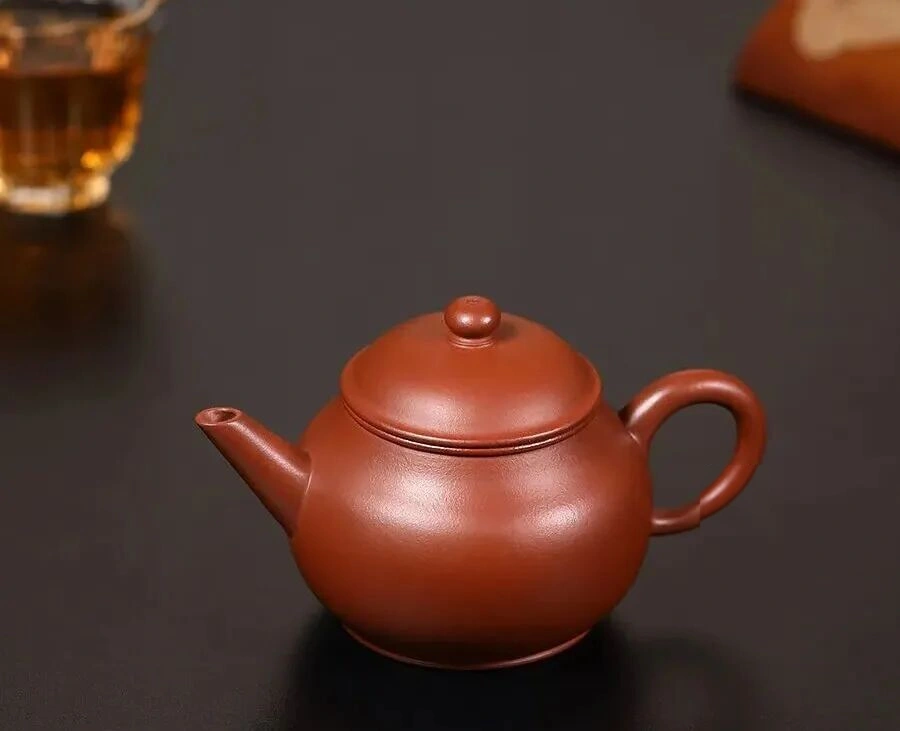
The featured photograph shows a Xishi form, attributed in the supplied article to Xu Zhiping. Like the other photographs here, it is a visual example; the picture does not establish the clay’s origin or authenticate the attribution.
1. Look at the Surface in Ordinary Light

Ask for daylight photographs of the body, lid, underside and interior. Look at the whole pot first, then the surface at a closer distance. Note the color, visible particles, shine and any patchy areas. If the seller’s photographs use dramatic lighting or a wet surface, ask for an additional dry view in softer light. A reflection can tell you more about the lighting than the clay.
The Chinese source praises a gentle, restrained sheen, sometimes described as shuise. That is an aesthetic observation, not a measurable authenticity test. A glossy pot is not automatically coated or false, and a matte one is not automatically genuine. Finishing, use, moisture and lighting all affect how a surface appears. Photos alone cannot reliably separate every possibility.

Color needs context, too. In ceramic firing, the kiln atmosphere can change the behavior of iron compounds and the resulting appearance; Digitalfire’s explanation of reduction firing illustrates why color is not simply a label for raw clay. You cannot work backwards from one dark or red photograph to a particular mine or recipe.
Visible grains are worth recording, but neither “more sand” nor “finer clay” is a universal quality rule. Ask how the clay was prepared and whether grains or other materials were blended in. A smooth-looking surface, isolated specks or an even distribution of particles does not answer that question on its own.
2. Touch Gently and Check the Finish
With the owner’s permission, hold the clean, cool pot with dry hands. Support the body securely and run a fingertip lightly over an undecorated area. Notice whether the surface feels even, slightly granular, sharp or sticky. Check the rim, lid edge and handle attachments for visible damage while you are there.

A surface can feel smooth even when grains remain visible. A pot should be pleasant to handle, but comfort alone does not establish authenticity. Texture depends on preparation, finishing and firing, and a newly fired surface may feel different from a well-used one. Warmth under your fingers is not a provenance test either.
Raised carving, applied decoration and painted areas also feel different from a plain body. Compare like with like. Do not scratch the clay, rub it with solvents or tap the lid against the body to listen for a supposedly correct note. Those actions can damage the piece and still leave the origin question unanswered. Our guide to tool marks and defects explains a separate issue: how to read visible working traces without turning them into proof of a making method.
3. Smell the Empty Pot Before Adding Tea
Smell the dry interior and underside before any seasoning or tea brewing. You are checking for an unexpected odor, not trying to identify a mine by scent. A musty storage smell, perfume or persistent solvent-like odor is a reason to pause and ask the seller about storage, cleaning and treatments. Do not brew tea to cover an unexplained smell before you have resolved the question.

Treat “earthy means genuine” as a claim to question. A faint smell does not identify the mineral body, and an odorless pot does not prove that it is free of unwanted substances. Smell is a screening observation, not a chemical test.
Food-contact suitability is a separate question from origin or handmade construction. An official Yixing quality-inspection notice describes testing teaware and raw clay for substance release and physical properties. The practical lesson is simple: where a safety claim matters, ask for relevant testing documentation rather than relying on your nose.
What the Three Checks Can Actually Tell You
| Check | Useful observation | What it does not prove |
|---|---|---|
| Look | Color, visible particles, finish and damage | Mine, mineral recipe or unaltered clay |
| Touch | Texture, handling comfort and rough edges | Yixing origin, maker or handmade construction |
| Smell | An odor that needs explanation | Chemical composition or food-contact safety |
Turn Your Observations into Questions for the Seller
If you like the pot, ask for evidence that matches the claim being made. Useful questions include: What does the stated clay name mean here? Is the clay supplier or batch recorded? Is this the exact pot shown in the photographs? Who made it, and what supports that attribution? Has it been colored, coated, restored or otherwise treated? What are the return terms if it differs from the description?
Written answers are more useful than an unexplained “original ore” label. A certificate may be part of the record, but its issuer and connection to the individual pot still need checking. Yixing’s published industry discussion specifically addresses clay quality and traceability, which is a better direction for inquiry than searching for one visual shortcut.
For a broader purchase checklist, use our guide to checking seller claims. Price and construction are separate topics: a low price does not by itself prove fake clay, while “fully handmade” does not establish a mineral source. Our Yixing teapot price guide and handmade construction comparison cover those distinctions.
Can You Authenticate a Yixing Clay Teapot at Home?
You can inspect its condition, record its appearance and identify claims that need more support. You cannot conclusively authenticate a Yixing clay teapot with look, touch and smell alone. For a valuable piece or a disputed material claim, seek an appropriately qualified assessment and ask what evidence would actually answer the question. Laboratory analysis can characterize a sample, but an origin claim still needs a credible record to connect it to a place and a pot.
That does not make the three checks pointless. They slow the purchase down enough to notice details and start a useful conversation. Choose a pot you enjoy handling, then give the clay story the same careful attention as the shape.
Image credits and attributions follow the supplied Chinese article. Overlaid brand watermarks were removed; the vessels’ original carved and painted decoration was retained. The photographs are illustrative and are not laboratory or provenance evidence.